Abstract:Stocks sank on Thursday to extend what is the worst first half of the year for global share prices on record, as investors fret that the latest show of central bank determination to tame inflation will slow economies rapidly.
Central bank chiefs from the Federal Reserve, European Central Bank and Bank of England met in Portugal this week and voiced their renewed commitment to control inflation no matter what pain it caused.
While there was little new in the messaging, it was another warning that the era of cheap cash which had turbocharged share prices for years is coming to an end.
By 0740 GMT, the MSCI World Equity Index was down 0.48%, bringing its year-to-date losses to more than 20% — the worst fall since the indexs creation.
The Euro STOXX dropped 1.53%, while the German DAX weakened 2.34%. Britains FTSE 100 was off 1.64%.
U.S. futures also fell, with little sign yet that the new quarter will bring in brave bargain hunters. This years dramatic slide in asset prices has been led by tech-heavy indexes and stocks more sensitive to rising interest rates.
“Fed Chair (Jerome) Powell and the FOMC (Federal Open Market Committee) don‘t want to get this one wrong. They want to be 90% sure that inflation is on the way down, not evenly balanced,” said Steve Englander, Standard Chartered’s head of global G10 FX research.
“So the signals they send become increasingly hawkish when they see the market as possibly prematurely pricing in victory over inflation.”

Traders are now focused on data on U.S. core prices due later in the session that are expected to underline the extent of the inflation challenge.
Swedens Riksbank became the latest to jack up borrowing costs, pushing its key rate to 0.75% from 0.25% as expected and flagging further sharp tightening to try and get price growth under control.
The Hungarian central bank also hiked, raising rates by 0.5% to 7.75%.
MSCIs broadest index of Asia-Pacific shares outside Japan eased another 0.5%, bringing its losses for the quarter to 10%.
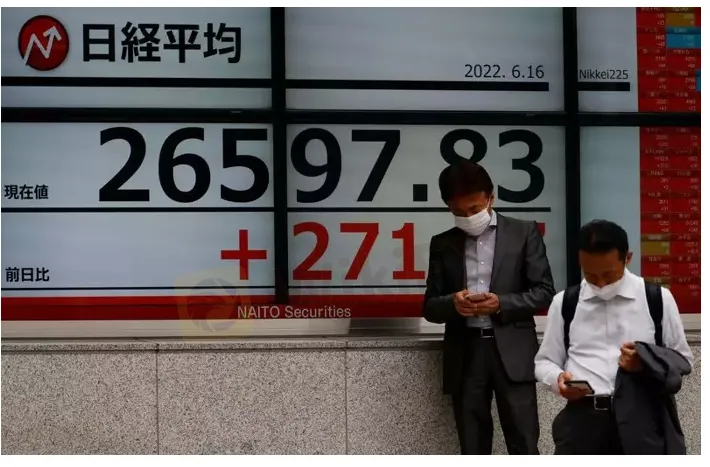
Japan‘s Nikkei fell 1.4%, though its drop this quarter has been a relatively modest 5% thanks to a weak yen and the Bank of Japan’s dogged commitment to super-easy policies.
The need for stimulus was underscored by data showing Japanese industrial output dived 7.2% in May, when analysts had looked for a dip of only 0.3%.
Chinese blue chips added 1.6% helped by a survey showing a marked pick up in services activity.
With investors so fearful of a sharp global economic slowdown caused by central banks tightening policy, some analysts are willing to call for a second-half rebound.
“It is not that we think that the world and economies are in great shape, but just that an average investor expects an economic disaster, and if that does not materialize risky asset classes could recover most of their losses from the first half,” JPMorgan wrote in a research note.
Dollar reigns supreme
The risk of recession was enough to bring U.S. 10-year yields back to 3.06% from their recent peak at 3.498%, though that is still up 74 basis points for the quarter and nearly 160 bps for the year.
The Feds hawkishness and an investor desire for liquidity in difficult times has gifted the U.S. dollar its best quarter since late 2016. The dollar index was marginally lower at 105.01 but just a whisker off its recent two-decade peak of 105.79.
The Swedish crown was little moved by the Riksbank rate hike, and was last at 10.688 crowns.
The euro inched higher to $1.0449, having shed 5.5% for the quarter so far and 8% for the year. It dropped to a new 7-1/2-year low versus the Swiss franc at 0.9963 francs.
The Japanese yen is in even worse shape, with the dollar having gained more than 12% this quarter and 18% this year to 137, its highest since 1998.
Oil prices, which have soared in 2022 along with most commodity prices, edged lower on Thursday amid concerns about an unseasonable slowdown in U.S. gasoline demand. [O/R]
OPEC and OPEC+ end two days of meetings on Thursday with little expectation they will be able to pump much more oil despite U.S. pressure to expand quotas.
Brent slipped 0.8% to $115.33 a barrel, while U.S. crude declined 0.47% to $109.27.