


UK Retail Sales July 2026 Fall 0.5%: What the Result Means for GBP
UK retail sales fell 0.5% in July 2026, while the three-month measure rose 1.1%. See the ONS details and what the mixed result may mean for GBP.
Original

简体中文
繁體中文
English
Pусский
日本語
ภาษาไทย
Tiếng Việt
Bahasa Indonesia
Español
हिन्दी
Filippiiniläinen
Français
Deutsch
Português
Türkçe
한국어
العربية
اردو




Abstract:Nigeria would experience a $15.1 billion foreign exchange imbalance as a result of the Federal Government's intention to end subsidies for premium motor spirits (PMS) in two months.
• Subsidy removal: Petrol could cost N800 per liter starting in June, but stakeholders doubt FG
• IPMAN claims Buhari has not yet complied with the CNG and LPG palliative agreement.
Nigeria would experience a $15.1 billion foreign exchange imbalance as a result of the Federal Government's intention to end subsidies for premium motor spirits (PMS) in two months.
Marketers have argued that the crisis brought on by the naira redesign strategy may recur unless a workable structure is developed to manage the transition to a deregulated market.
PMS alone costs over $15.1 billion (N7 trillion) per year to import. The lone importer, Nigerian National Petroleum Company Limited (NNPCL), provides the funding for the expenditures.
The Central Bank of Nigeria (CBN) only provided roughly $1.3 billion last year for the importation of fuel, the majority of which was diesel and kerosene.
According to Tunji Oyebanji, a former chairman of the Oil Marketers Association of Nigeria (MOMAN), marketers are now unaware of how the Federal Government wants to handle the impending deregulation of the market and the tenacious FX problem.
It's possible that the FX subsidy program for marketers is similar to the PMS subsidy program. Additionally, it's possible that the Central Bank of Nigeria (CBN) has the liquidity buffer necessary to finance PMS imports, and obtaining dollars on the black market may be difficult and expensive.
The average price of PMS in Chad, Cameroun, Benin, and Ghana, where most of the illegally imported, subsidised petroleum from Nigeria is shipped to, is $1.078 per litre. Nigerian merchants may face market disincentives if they sell below the cutoff.
A sub-regionally competitive PMS pricing might peg at roughly N500 if the marketers obtain FX from the Investors' and Exporters' (I&E) FX window, which is not likely due to liquidity and other issues. However, when compared to the parallel market, PMS will trade between N780 and N800.
He claims that marketers are unsure of whether the CBN will furnish them with foreign exchange or if NNPC will continue to be the only importer of the good.
Oyebanji warned that regardless of the strategy the government chose, if it wasn't made public, the nation would experience a catastrophe such to the one that occurred a few months ago when it attempted to implement the naira redesign program.
We are arguing that a very clear plan is necessary to keep all stakeholders involved. This is a key issue in my opinion.
For instance, will other products be imported after we remove subsidies? We need to know now, not after the subsidy is taken away. We must have placed an order if they are importing. We must know if NNPC would be importing. Everyone must agree on the same position, according to Oyebanji.
There is a need to create an equal playing field, according to Oyebanji, who argued that the industry regulator must do the opposite of discouraging investment and encourage it.
He thinks it's not desirable for NNPC to continue to be the dominant force while other players are hurt.
The Federal Government has already borrowed $800 million for a palliative that would ease subsidy removal, which is anticipated to begin in June, just three days after a new government takes office. However, the lack of clarity from the government regarding how it intends to handle the market and the import side of the market worries the majority of marketers.
Energy expert Henry Adigun warned that if the future administration follows the current administration's plan to remove gasoline subsidies, the nation would face tremendous economic hardship.
Adigun stated that the wisest course of action for the next government is to build up a transition mechanism for subsidy removal, despite the fact that the government led by President Muhammadu Buhari has gone to borrow $800 million as a palliative for subsidy removal.
I don't believe the subsidies will be removed right away after handover. That would result in a serious economic crisis and societal unrest. The difficulty won't be restricted to supply. Nigerians may also be the target of extortion.
Creating a transition procedure is the best course of action for Bola Tinubu. With strong stakeholder involvement and a phased pullout, he said.
Abubakar Shettima, a member of the leadership of the Independent Petroleum Marketers Association of Nigeria (IPMAN), predicted that after the subsidy is eliminated, the price of PMS will increase to roughly N800 per litre.
He claims that despite the president and marketers having a meeting last year to discuss palliative measures that would help them transition to a business model that includes both compressed natural gas and liquefied petroleum gas across retail outlets, nothing has come of the proposal.
“Government needs to get serious and be clear about what needs to be done,” said Gillis-Harry. For things like currency and other things, there must be an even playing field. The cost of PMS will be roughly N800 per litre if we have to seek foreign currency ourselves.
Segun Ajibola, a professor of economics at Babcock University and the former president of the Chartered Institute of Bankers of Nigeria (CIBN), remarked that the estimated import bill of $15 billion is merely a foreshadowing of the change in the status quo that may alter come June 2023 for a number of reasons.
According to him, this was done so that the incoming government could evaluate the facts surrounding the subsidy issue comprehensively. Therefore, the June 1 deadline for subsidy elimination may not be final after all. I think the numerous gaps, particularly product leakages across borders, will be closed in order to lower the praised daily consumption rate.
The marketer should therefore bring things and sell them at the market clearing price. Allow NNPCL to sell at marginal cost pricing for a limited period of time to ensure that it will accept a return on investment through price modulation, Iledare stated.

Disclaimer:
The views in this article only represent the author's personal views, and do not constitute investment advice on this platform. This platform does not guarantee the accuracy, completeness and timeliness of the information in the article, and will not be liable for any loss caused by the use of or reliance on the information in the article.
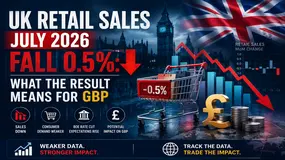
UK retail sales fell 0.5% in July 2026, while the three-month measure rose 1.1%. See the ONS details and what the mixed result may mean for GBP.
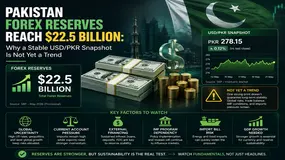
Pakistan forex reserves stood at $22.506 billion on 13 August 2026, while the SBP dashboard showed a USD/PKR mark to market rate of 277.5713 on 20 August. This article separates the SBP forex reserves facts from predictions about the Pakistan rupee and the forex market Pakistan.
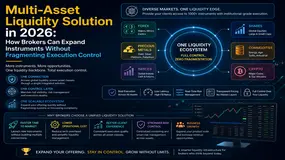
A multi-asset liquidity solution can help a broker support FX, CFDs, commodities, and indices through a more unified operating model. But adding asset classes can also create fragmented symbols, pricing, routing, margin rules, records, and client messages if controls are not designed first. This 2026 guide explains how a multi asset liquidity provider, forex CFD liquidity setup, commodity liquidity provider, and indices liquidity provider fit into a broker-owned execution service. It outlines the due-diligence questions, shared-control model, cost drivers, and 90-day implementation plan that help teams expand without making the execution chain harder to explain. The aim is not to promise deeper liquidity or better trading outcomes. It is to create evidence that a broker can supervise market access, trace order events, reconcile costs, and communicate consistently to the relevant clients when conditions are difficult.

Gold surged above $4,500 after the US Treasury expanded its purchases of longer-dated government bonds, pushing yields and the dollar lower. But this was not debt forgiveness or Federal Reserve money printing—it was a liquidity operation that exposed a much bigger fear: America may be finding it increasingly difficult to live with market-driven interest rates.
WikiFXWikiFXWikiFXWikiFXWikiFXWikiFXWikiFXWikiFXWikiFXWikiFX