


UK Retail Sales July 2026 Fall 0.5%: What the Result Means for GBP
UK retail sales fell 0.5% in July 2026, while the three-month measure rose 1.1%. See the ONS details and what the mixed result may mean for GBP.
Original

简体中文
繁體中文
English
Pусский
日本語
ภาษาไทย
Tiếng Việt
Bahasa Indonesia
Español
हिन्दी
Filippiiniläinen
Français
Deutsch
Português
Türkçe
한국어
العربية
اردو




Abstract:Local firms have voiced concerns about cost increases given that prices have continued to rise as a result of supply chain difficulties brought on by shortages and rising foreign exchange rates (forex).
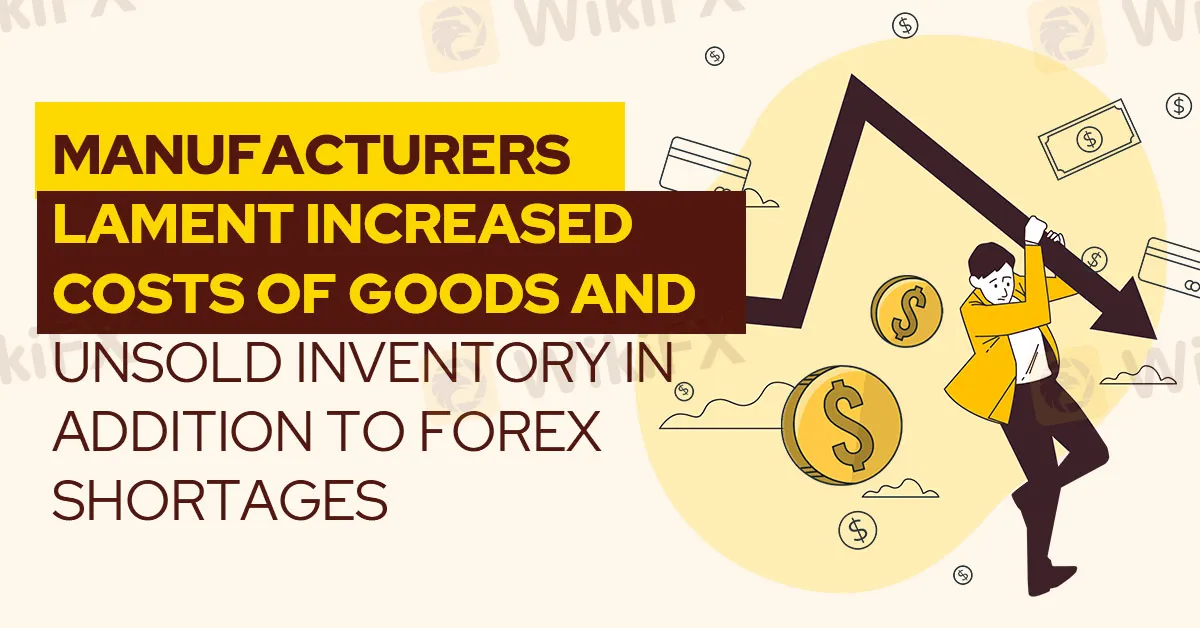
Local firms have voiced concerns about cost increases given that prices have continued to rise as a result of supply chain difficulties brought on by shortages and rising foreign exchange rates (forex).
According to the Manufacturers Association of Nigeria's (MAN) Executive Summary of Bi-Annual Economic Review published for the second half of 2022, the growing expenses have therefore caused a 51 percent increase in finished goods that have not been sold.
According to a recent statement from MAN, the exorbitant premium that still exists between the official and parallel exchange rates has further slowed manufacturing operations despite the recent reform to unify all FX windows.
The operators have asked the CBN to establish an exchange rate trading range for them in order to slow the rise in manufacturing costs that have been exacerbated by the lack of liquidity in the foreign exchange (FX) market, which has decreased industrial production.
Given that the nation is heavily dependent on the import of raw materials, the Naira's depreciation and the lack of available foreign exchange for purchases are adversely impacting the price of imported raw materials and driving up production costs.
Additionally, high energy and logistical costs, among other things, have contributed to production levels, capacity utilization, and employment losses, among other things.
Frank Onyebu, the immediate past chairman of MAN's Apapa branch, spoke, claiming that the fast rising cost of foreign exchange is seriously harming Nigeria's manufacturing industry.
According to Onyebu, the industry is experiencing an existential crisis as a result of the uncertainty brought on by these escalating expenses. This industry is already plagued by infrastructure problems and other problems.
Effective planning is virtually hard for manufacturers, who are compelled to modify their plans frequently and rely mostly on short-term solutions.
The cost of production has increased as a result of these rising costs generally. Unfortunately, the weak state of the economy makes it impossible to raise the pricing of their products in a way that is reasonable. As a result, producers are left with a big inventory of finished goods that they are unable to sell. The bottom line is certainly affected, he said.
He bemoaned the sharp rise in the stock of unsold completed goods and mentioned how the economy was harming consumers' purchasing ability.
The fact that many manufacturers are failing and others are moving to nations with less instability is therefore not surprising.
He urged the government to “respond with appropriate measures to resolve the FX market crisis as soon as possible.” This will help the manufacturing industry grow and promote consumer confidence in the economy as a whole.
Part of the additional cost of gasoline, transportation, and moving raw materials from one location to another, according to Mr. Imokhai Ehimigbai, Export Manager at Aarti Steel Ltd. and a member of the MAN Export Group (MANEG), is transferred to the consumer because no manufacturer would want to operate at a loss.
Raw resources are expensive. Today, we look for foreign exchange to import cold roll, a raw material that Nigeria is able to produce. But because Itakpe and Ajaokuta Steel aren't operating, we must import hot roll. Nigerian manufacturing are impacted by this.
He lamented the fact that some industries were already leaving the nation while others were closing.
With the current dollar exchange rate, importing raw materials is ludicrous. In the end, the price is exorbitant and because Nigerians' purchasing power has been impacted, no one will buy; as a result, the warehouses are full.
Companies are laying off employees.
The MAN president has already started yelling about the unavoidable job losses.
We pay for gas in dollars; although you pay in naira, electricity is dollarized and charged in dollars.
Because there are not enough raw materials available, many industries cannot produce at 30% of their potential.
He claims that manufacturers have had a very difficult time lately. In order to mitigate this in our situation, we have significantly decreased our production capacity.
In the exchange market, the naira has no value. Even cross-border commerce is impacted.
Everything in Nigeria is dollarized because it is not a producing country. The value chain is affected by the high dollar rate, which is taken into account during production and results in high prices for goods and services. And because they are unable to purchase, consumers.
The MANEG member emphasized the need for manufacturers to have their own window to import raw materials.
Additionally, he suggested that the government investigate the solid minerals sector.
Nigeria would recover in three to four years if this is done. As it is now, oil will soon run out for us.
Apart from oil, we are fortunate to have other material resources.
He urged the CBN to address the issue of Bureau of Change speculating, as this behavior is a contributing factor to the rising exchange rate.

Disclaimer:
The views in this article only represent the author's personal views, and do not constitute investment advice on this platform. This platform does not guarantee the accuracy, completeness and timeliness of the information in the article, and will not be liable for any loss caused by the use of or reliance on the information in the article.

UK retail sales fell 0.5% in July 2026, while the three-month measure rose 1.1%. See the ONS details and what the mixed result may mean for GBP.

Pakistan forex reserves stood at $22.506 billion on 13 August 2026, while the SBP dashboard showed a USD/PKR mark to market rate of 277.5713 on 20 August. This article separates the SBP forex reserves facts from predictions about the Pakistan rupee and the forex market Pakistan.

A multi-asset liquidity solution can help a broker support FX, CFDs, commodities, and indices through a more unified operating model. But adding asset classes can also create fragmented symbols, pricing, routing, margin rules, records, and client messages if controls are not designed first. This 2026 guide explains how a multi asset liquidity provider, forex CFD liquidity setup, commodity liquidity provider, and indices liquidity provider fit into a broker-owned execution service. It outlines the due-diligence questions, shared-control model, cost drivers, and 90-day implementation plan that help teams expand without making the execution chain harder to explain. The aim is not to promise deeper liquidity or better trading outcomes. It is to create evidence that a broker can supervise market access, trace order events, reconcile costs, and communicate consistently to the relevant clients when conditions are difficult.

Gold surged above $4,500 after the US Treasury expanded its purchases of longer-dated government bonds, pushing yields and the dollar lower. But this was not debt forgiveness or Federal Reserve money printing—it was a liquidity operation that exposed a much bigger fear: America may be finding it increasingly difficult to live with market-driven interest rates.
WikiFXWikiFXWikiFXWikiFXWikiFXWikiFXWikiFXWikiFXWikiFXWikiFX