


IG Review for India 2026: RBI Alert List, Regulation, Login, and Forex Risk
IG review for India in 2026: see the RBI Alert List entry, overseas regulation, login checks, forex limits, and a clear broker safety checklist.
Original

简体中文
繁體中文
English
Pусский
日本語
ภาษาไทย
Tiếng Việt
Bahasa Indonesia
Español
हिन्दी
Filippiiniläinen
Français
Deutsch
Português
Türkçe
한국어
العربية
اردو




Abstract:Stumbled over the term forex swap and could not find its meaning, relevance and implication? In this quick guide, we’ll explain forex swaps in the simplest terms possible.

Stumbled over the term forex swap and could not find its meaning, relevance and implication? In this quick guide, well explain forex swaps in the simplest terms possible. So, what is a swap in forex trading? It is simply an agreement made between two foreign parties to swap interest payments on a loan made in one currency for interest payments on a loan in another. It can even involve the exchange of principal amounts. As the agreement concludes, the principal amount would be exchanged back. A swap in forex typically involves a notional principal used for calculating interest. However, it does not get exchanged. To know more about this topic, keep reading!
The most significant purpose behind executing a currency swap agreement is to obtain loans in foreign currency at attractive interest rates than what might be the case when borrowing directly in a foreign market. During the 2008 financial crisis, the US Federal Reserve allowed several liquidity-strapped countries to swap currencies to meet urgent borrowing needs.
Salomon Brothers, an investment banking firm, arranged the currency swap transaction wherein the World Bank and IBM agreed to the very first transaction of this sort in 1981. As part of the transaction, IBM swapped German Deutsche marks and Swiss francs for US dollars to the World Bank.
The execution of forex swaps is done through loans with maturities up to 10 years. These swaps differ from interest rate swaps by involving principal exchanges.
The foreign currency swap, as explained above, is an agreement by which one party pays interest charged on the principal loan amount of another party throughout the agreement tenure. As the swap gets over, the principal amounts get exchanged one more time at the agreed rate. Currency swap rates used to be tied to the London Interbank Offered Rate (LIBOR), an average interest rate used by international banks when borrowing from each other. It is used as a benchmark for other overseas borrowers. Swaps are also benchmarked based on the Secured Overnight Financing Rate (SOFR) from 2023.
Swaps in forex are of many types, which have been explained below.
In this arrangement, the parties give consent to exchange fixed interest rate payments in two currencies. Commonly used by the two parties seeking predictable interest payments, the arrangement prevents them from facing potential uncertainty arising from interest payment fluctuations due to floating rates.
This arrangement involves different types of interest rate payments from two parties. Here, one party makes fixed interest payments, and another one pays based on the floating rate, such as SOFR. This swap is reflective of a certain payment structure that one party wants, while the other party intends to capitalize on potential interest rate changes.
The swap involves the exchange of interest rate payments from both parties based on the prevailing floating rates in their respective currencies. Also called a basis swap, this helps both parties to maximize the potential interest rate movement across different markets.
This swap is designed to reduce the notional amount over time, helping users align with a principal repayment schedule. Whenever the parties seek swap alignment with an amortizing loan, such as project finance, they can enter into this swap agreement. With this, both parties exchange interest payments on reducing principal amounts.
This type of swap involves the notional principal rising over time.
A zero-coupon currency swap will have one party paying interest regularly while the other party pays all the interest on maturity.
Securing cheaper debt is the common reason why investors opt for currency swaps. For instance, European Company B procures a loan worth $120 million from US Company C. At the same time, US Company C takes a loan worth 100 million euros from European Company B. The $1.2 spot rate, indexed to LIBOR, decides the exchange between these two companies. The companies entered into the contract because it helps them obtain currencies at an attractive rate. If there is an exchange of principal in a currency swap deal, the principal will be exchanged again on maturity.
Currency swaps are also used by companies to lower exposure to anticipated exchange rate fluctuations. Usually, these risks arise when companies conduct business globally. So, they would like to hedge such risks by acquiring opposite and simultaneous currency positions. As they no longer require hedging, companies can unfold the swap. The potential losses owing to fluctuating exchange rates can be offset by the profit earned through the swap. As a result, companies continue to operate without any interruption.
Conclusion
Forex swaps are essential financial instruments that offer flexibility, cost-efficiency, and risk management to investors and multinational companies. Whether it's for securing better interest rates, managing currency exposure or structuring long-term funding, currency swaps are a strategic solution to navigate the forex market. Understanding the types, processes and real-world applications of forex swaps, traders can make more informed investment decisions.
Find the Latest Forex Updates on WikiFX Masterminds
Join it by following these simple steps -
1. Scan the QR code placed right at the bottom.
2. Download the WikiFX Pro app.
3. Afterward, tap the ‘Scan’ icon placed at the top right corner
4. Scan the code again.
5. Congratulations, you are part of the community.

Disclaimer:
The views in this article only represent the author's personal views, and do not constitute investment advice on this platform. This platform does not guarantee the accuracy, completeness and timeliness of the information in the article, and will not be liable for any loss caused by the use of or reliance on the information in the article.

IG review for India in 2026: see the RBI Alert List entry, overseas regulation, login checks, forex limits, and a clear broker safety checklist.

Orbex, a Cyprus-based brokerage entity, has recorded 30 exposure complaints on WikiFX, a leading forex broker regulation inquiry tool, so far. Other review websites have also recorded a healthy number of complaints against the brokerage firm. These complaints largely talk about the alleged profit confiscations by the broker in the name of trading violations, difficulty in accessing fund withdrawals, capital losses due to artificial slippage, etc. In this Orbex review, we have investigated user complaints and provided a regulatory overview of the broker.
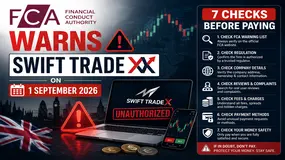
FCA warns Swift TradeX in a notice first published and updated on 1 September 2026. The UK Financial Conduct Authority says the firm may be providing or promoting financial services without permission, is not authorised, and may be targeting people in the UK. The notice names the website swifttradexai.com, a Worcester address and a UK telephone number, but also cautions that unauthorised businesses may use incorrect or borrowed contact details. The confirmed issue is authorisation status—not a court finding about every transaction. Anyone considering a payment should stop, verify the firm independently, and avoid using contact information supplied by the platform itself.

ThinkMarkets review for India: check the RBI Alert List, overseas entities, regulation, login security, forex rules, costs, withdrawals, and leverage risk.
WikiFXWikiFXWikiFXWikiFXWikiFXWikiFXWikiFXWikiFXWikiFXWikiFX