Abstract:CFTC clarifies rules for foreign crypto and derivatives exchanges seeking U.S. access via FBOT registration, ending regulatory ambiguity for digital asset and traditional markets.
CFTC Ends Years of Regulatory Gray Area for Offshore Exchanges
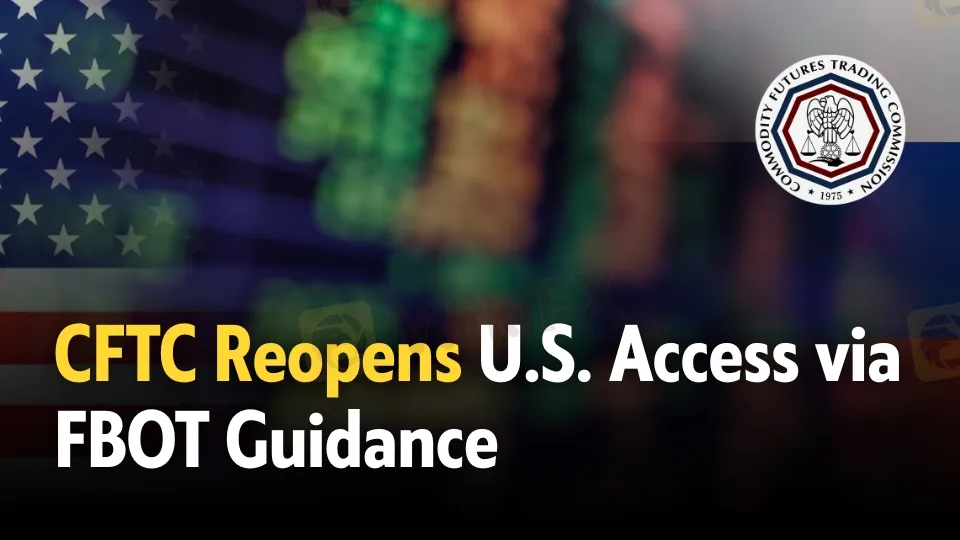
The U.S. Commodity Futures Trading Commission (CFTC) issued a pivotal advisory on August 28, 2025, reinforcing its foreign board of trade (FBOT) registration framework for non-U.S. exchanges seeking to serve American participants. The guidance provides regulatory clarity for non-U.S. exchanges and restores lawful direct access for U.S.-located traders—including on platforms offering digital asset derivatives—following years of market uncertainty and what Acting Chair Caroline D. Pham called “regulation through enforcement”.
Pham stated the new advisory was designed to dispel confusion caused by recent enforcement actions and “novel interpretations” of registration rules that had pushed much of the industry offshore. “American companies that were forced to set up shop in foreign jurisdictions to facilitate crypto asset trading now have a path back to U.S. markets,” she said. With this move, the CFTC reaffirms a framework originally established in the 1990s, which applies to all asset classes, including cryptocurrency exchanges that were previously locked out of U.S. markets due to registration challenges.
How the FBOT Registration Framework Works for Crypto and Derivatives Businesses
Under CFTC Part 48, foreign boards of trade must register with the agency to legally provide direct market access for U.S. traders. The process is open to non-U.S. exchanges for both traditional and digital asset products, provided those exchanges maintain robust regulatory oversight in their home country, enforce strict trading rules, demonstrate financial integrity, and establish information-sharing arrangements with U.S. regulators. Supervision comparability is a core requirement: exchanges must submit to comparable regulatory regimes abroad and agree to ongoing compliance checks by U.S. authorities.
The advisory is a response to mounting industry inquiries about FBOT eligibility and whether non-U.S. crypto or derivatives platforms should register as an FBOT or a designated contract market (DCM). The CFTC clarified that the FBOT registration process is the simplest, established pathway for foreign exchanges seeking U.S. access, and that novel enforcement actions will no longer create ambiguity for compliant international platforms.
Impact on Binance, Bybit, and the Future of U.S. Crypto Trading
This regulatory clarification is likely to reshape the U.S. digital asset landscape. Major offshore crypto derivatives exchanges—such as Binance, which exited the U.S. market entirely in 2023—could potentially return to serving American customers if they successfully obtain FBOT registration. Bybit, Bitget, and other leading global platforms may also explore new U.S. market opportunities under the FBOT framework, provided they meet the supervisory and compliance requirements.
The advisory directly addresses years of industry frustration over inconsistent enforcement and lack of clear rules, which Pham said had “driven trading activity out of the United States.” Now, with regulatory clarity for digital assets, both crypto and traditional offshore exchanges have a defined, transparent process to legally serve U.S. customers—opening the door for renewed competition and deeper liquidity in U.S. markets.
Moving Forward: Compliance, Competition, and Market Access
The CFTCs guidance emphasizes that FBOT registration is neither a shortcut nor a guarantee of market entry. Compliance, supervision, and comparability with U.S. standards are non-negotiable, and enforcement will continue to target firms that skirt the rules. However, for exchanges that meet the criteria, direct access for U.S.-located traders to global liquidity—including crypto derivatives—is now officially sanctioned.
Caroline D. Pham reiterated that the CFTC‘s advisory is a reaffirmation of its longstanding, flexible approach to supporting market access and innovation, rather than a sweeping deregulation. “We are offering U.S. traders diverse choices and access to the world’s deepest and most liquid markets, as well as a rich array of products and asset classes,” she said.
For the crypto industry, particularly those firms that relocated due to regulatory uncertainty, the CFTCs FBOT advisory represents a significant step toward regulatory normalcy—and a potential new chapter for digital asset trading in the United States.