Abstract:Entering 2026, diverging central bank policies are reshaping global FX and bond markets, while economic momentum shifts from developed economies toward India. Meanwhile, an upcoming leadership transition at the US Federal Reserve presents a key underappreciated risk that could trigger renewed volatility in interest rates and the US dollar.

As we head into 2026, global markets are emerging from what was a difficult yet pivotal year in 2025. With inflation pressures easing, geopolitical tensions lingering, and economic growth becoming increasingly uneven, major target="_blank" kwlink="6384064000816950219725">target="_blank" kwlink="6384064000971585773080">central banks have begun responding in markedly different ways. These diverging policy paths are setting the stage for a year that could be volatile and increasingly polarised, rather than uniformly directional.
Looking back at 2025, central bank decisions played a defining role in shaping currency and bond markets. The US Federal Reserve ended its long tightening cycle in December by cautiously cutting rates to a range of 3.5% to 3.75%. The decision was notable not only for the shift in policy direction, but also for the unusually split 9–3 vote among policymakers, highlighting deep uncertainty over the outlook. In Europe, the European Central Bank paused further tightening after inflation stabilised close to its 2% target, choosing a data-driven approach to support economic stability. The Bank of England, facing stubborn inflation alongside weak growth, entered 2026 holding rates steady, reflecting a careful balancing act. Japan stood apart, with the Bank of Japan raising rates to 0.75% in December as part of its slow and deliberate move toward policy normalisation. Together, these contrasting paths widened yield differentials, softened the US dollar, supported the euro, and left the yen increasingly sensitive to carry trades and shifts in risk sentiment. As 2025 closed, market focus clearly shifted from the end of rate hikes to the growing divergence among global central banks.
That divergence becomes even more pronounced as these institutions move into 2026. For the Federal Reserve, December 2025 marked a turning point as it began easing away from peak interest rates. Official projections suggest only modest cuts ahead, with rates expected to ease from around 3.6% at the end of 2025 to roughly 3.4% by the end of 2026. This cautious stance reflects an effort to support a slowing economy without reigniting inflation. Adding a layer of uncertainty is the upcoming leadership transition at the Fed, with Jerome Powell‘s term set to end in May 2026. Markets are watching closely for signals on his successor, as any perceived shift in the Fed’s independence could trigger sharp moves in bond yields and the US dollar.
In Europe, the ECBs steady posture reflects growing confidence that inflation pressures are easing, allowing it to prioritise stability over further tightening. The Bank of England remains more guarded, with any move toward easing likely to depend heavily on incoming inflation and growth data. Meanwhile, Japan continues along its own path of gradual normalisation, seeking to restore policy flexibility without unsettling financial markets. This approach keeps the yen closely tied to global yield movements and broader risk appetite.
For foreign exchange markets, these policy differences mean yield spreads will remain a key driver of currency performance. The US dollar may face cyclical pressure as easing expectations build, while the yen remains particularly sensitive to carry trade dynamics. In calmer, low-volatility conditions, yield-seeking strategies could regain popularity, especially when funded with low-yield currencies.
Beyond monetary policy, 2026 looks less like the start of a recession and more like a macroeconomic reset. Global growth is expected to slow but remain resilient, with downside risks present yet largely manageable rather than systemic. Disinflation is continuing, though unevenly, as services inflation and wage pressures prove more persistent. Growth drivers are also shifting. While developed economies cool, emerging markets play a larger role. China continues rebalancing toward domestic demand, while India is emerging as a standout growth engine, with expansion projected at over 7%, helping to reshape the broader emerging market landscape. At the same time, high fiscal deficits and political uncertainty in several major economies continue to influence bond markets, risk premia and investor sentiment.
Across asset classes, the outlook for 2026 reflects these mixed forces. In FX markets, a narrowing of rate differentials could weigh on the dollar against currencies like the euro and pound, favouring selective positioning over broad directional trades.
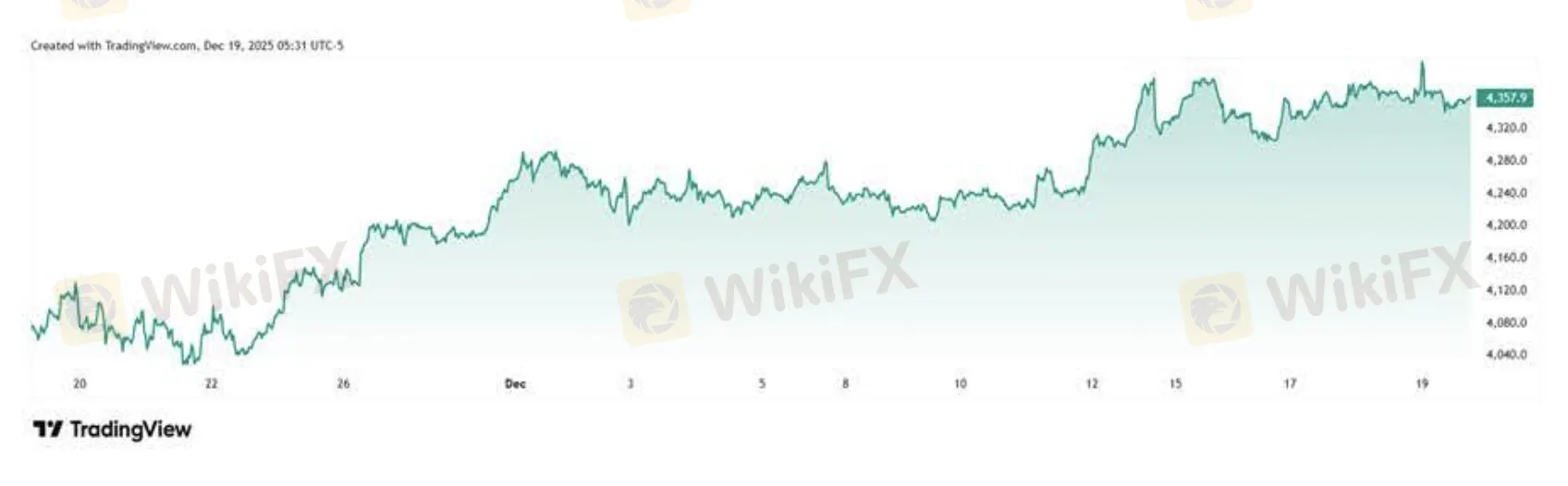
Source: TradingView.com – November 2025 to December 2025
Gold ended 2025 on a strong note, driven by central bank buying and persistent geopolitical uncertainty, and is widely seen as retaining its appeal as a portfolio hedge in an increasingly unpredictable world.
Oil markets, despite ongoing geopolitical risks, face supply-heavy conditions that may limit upside potential. In crypto markets, regulatory developments and greater institutional participation remain key themes, though volatility and unique risks persist.
Equity markets globally remain broadly constructive, supported by strong earnings expectations in sectors such as artificial intelligence and defence, but performance is likely to vary widely across industries and regions.
As markets become more fragmented, several key drivers will shape short-term volatility in 2026. Early in the year, large-scale portfolio rebalancing by institutions could temporarily distort yields, currencies and equity indices. Prolonged low volatility may encourage risk-taking strategies such as carry trades, increasing vulnerability to sudden data surprises or policy shifts. Seasonal liquidity constraints at the start of the year could also amplify market reactions to geopolitical developments or economic releases.
Against this backdrop, a few events will be particularly important to watch. Key economic data, including US labour and inflation reports, eurozone inflation updates and Chinas PMI figures, will help assess growth resilience and policy direction. Developments surrounding the Federal Reserve leadership transition in May could prove pivotal for the dollar and bond markets. Early earnings reports from sectors such as technology, biotech and defence will test expectations for growth in 2026. Meanwhile, geopolitical developments, especially around US–China relations and disruptions to major trade routes, remain a persistent source of potential volatility.
Overall, 2026 is shaping up to be a year defined less by a single narrative and more by divergence, selective opportunities and the need for careful risk management in an increasingly complex global landscape.