


Global Broker Regulation Inquiry App
About WikiFX
English
简体中文
繁體中文
English
Pусский
日本語
ภาษาไทย
Tiếng Việt
Bahasa Indonesia
Español
हिन्दी
Filippiiniläinen
Français
Deutsch
Português
Türkçe
한국어
العربية
اردو
DBG Markets | The Invisible Hand: Understanding FX Intervention (and Why Japan is Obsessed with It)
Abstract:The Invisible Hand: Understanding FX Intervention (and Why Japan is Obsessed with It)If you have been trading USD/JPY recently, you know the feeling. The pair climbs steadily, breaking resistance afte

The Invisible Hand: Understanding FX Intervention (and Why Japan is Obsessed with It)
If you have been trading USD/JPY recently, you know the feeling. The pair climbs steadily, breaking resistance after resistance, and then out of nowhere, it crashes 400 pips in a short period of time.
Was it a data release? No. Was it a sudden war? No. It was the FX intervention.
Welcome to the world of FX Intervention. In 2026, Japan has become the global battleground for this high-stakes poker game between the free market and the government. But what exactly is intervention, why do countries do it, and more importantly—how can you survive (and profit) when the “Invisible Hand” strikes?
In this article, DBG Markets breaks down the mechanics of the ultimate market mover.
1. What is FX Intervention?
Foreign Exchange (FX) Intervention is when a central bank or government actively enters the market to buy or sell its own currency to influence its value.
· The Goal: To stabilize the exchange rate, prevent excessive volatility, or protect the countrys economic interests (like exports or inflation control).
· The Player: In most countries, the Central Bank does this. In Japan, the Ministry of Finance (MoF) orders the intervention, and the Bank of Japan (BoJ) executes it.
2. The Two Types of Intervention
Not all interventions involve actual money. Governments often play “mind games” first. Here are the two most common seen in the currency market intervention:
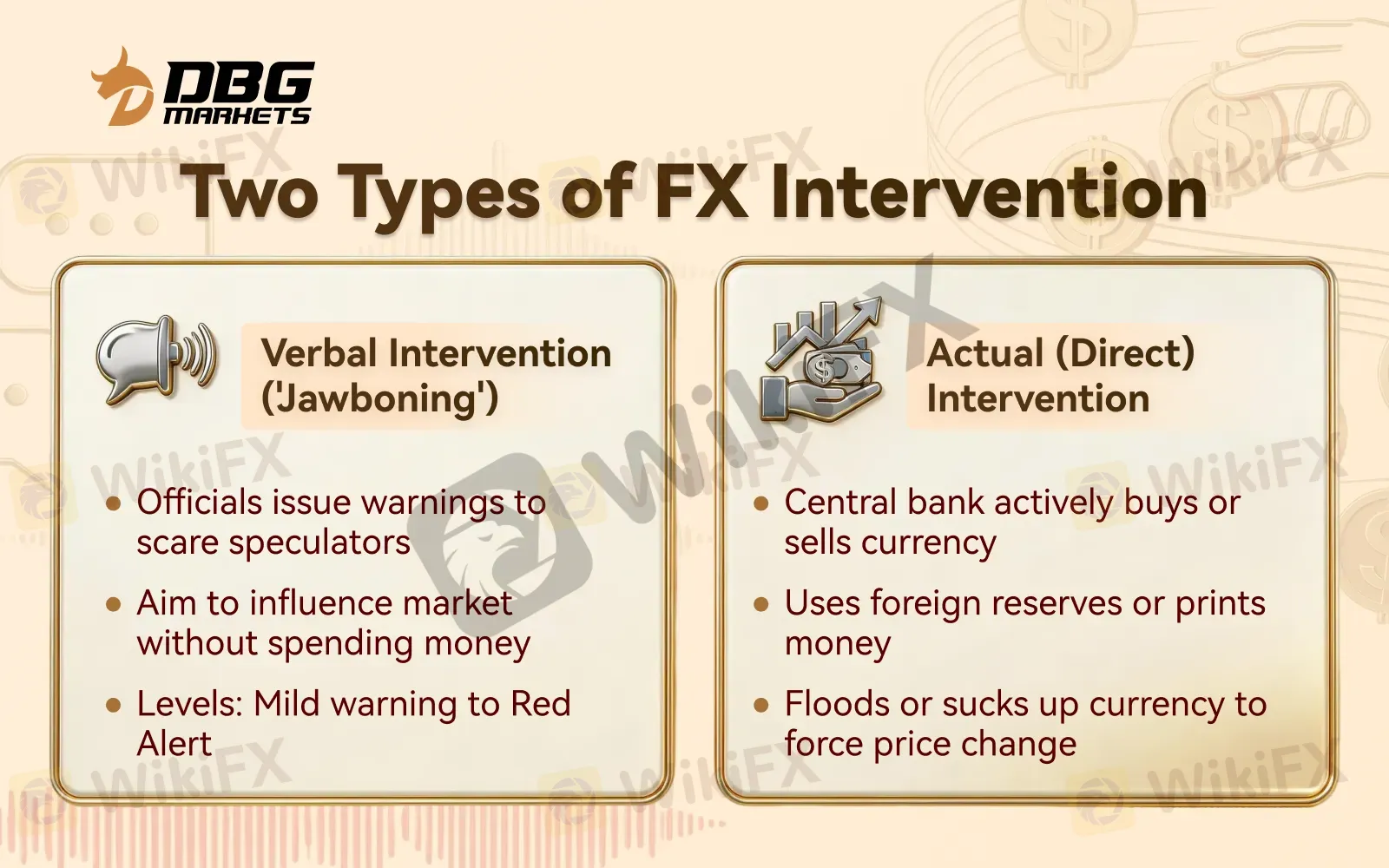
2.1. Verbal Intervention (“Jawboning”)
This is the first line of defense. Officials issue warnings to scare speculators without spending a dime.
· Level 1 (Mild): “We are watching currency movements closely.”
· Level 2 (Strong): “Excessive moves are undesirable.”
· Level 3 (Red Alert): “We are ready to take decisive action at any time.” (Japan is famous for this phrase).
B. Actual (Direct) Intervention
When talk fails, they act, this is where central bank usually starts to take the real action.
· To Strengthen Currency (e.g., Japan Buying Yen): The central bank sells its foreign reserves (usually US Dollars) and buys its own currency (Yen). This floods the market with USD and sucks up JPY, forcing the price of USD/JPY down.
· To Weaken Currency (e.g., Swiss Franc in 2011): They print their own currency and sell it to buy foreign assets.
3. Why Is Japan the “King” of Intervention?
Japan is the perfect case study because it intervenes more frequently than almost any other G7 nation. Why?
1. Export Dependency: Japans economy relies on selling cars and electronics (Toyota, Sony) abroad. If the Yen is too strong, their products become expensive, and profits tank.
2. Imported Inflation: Conversely, if the Yen is too weak (like in 2025-2026), the cost of importing energy and food skyrockets, hurting Japanese households.
Currently, Japan is fighting the second problem: A Yen that is too weak. They are intervening to stop the “bleeding” and prevent the currency from collapsing.
4. Does It Actually Work?
Intervention is powerful and can be very impactful to the financial market or the forex market, but it is not invincible or ultimately works all the time.
· Short-Term: Yes, it works. A sudden multi-billion dollar sell order can smash a currency pair down instantly, triggering stop-losses and panic selling.
· Long-Term: However, for long-term, It is debatable. If the fundamental economic gap (like the interest rate difference between the US and Japan) is too wide, the market will eventually swallow the intervention.
Traders Rule: “You can slow the tide, but you can't stop the ocean.” Intervention usually buys time, but it rarely reverses a long-term trend unless monetary policy changes with it or supported with fundamental.
5. How to Trade (or Survive) an Intervention
Trading during intervention risk requires a specific set of rules.
1. Watch the “Lines in the Sand” Governments often defend psychological levels (e.g., 150.00, 152.00, or 160.00 on USD/JPY). If price approaches these zones and slows down, be alert for verbal warnings.
2. Don't Chase the Spike When intervention happens, the price moves fast. If you are not in the trade, do not chase it immediately. Often, the price will retrace 50% of the intervention move as buyers step back in to “buy the dip.”
3. Respect the “Checkmate” If the MoF announces a “Rate Check” (calling banks to ask for price quotes), it is often the final warning before they pull the trigger. If you hear news of a “Rate Check,” tighten your stops or exit long positions immediately.
Conclusion: The Trader's Edge
FX intervention is the “nuclear option” of the currency market. It creates massive risks for the unprepared, but huge opportunities for the vigilant.
As we move through 2026, the battle for the Yen is far from over. By understanding the language of the MoF and the mechanics of the BoJ, you can turn this volatility from a threat into an edge.
Stay updated with DBG Markets for real-time alerts on potential interventions and key levels to watch.

Disclaimer:
The views in this article only represent the author's personal views, and do not constitute investment advice on this platform. This platform does not guarantee the accuracy, completeness and timeliness of the information in the article, and will not be liable for any loss caused by the use of or reliance on the information in the article.
WikiFX Broker
Latest News
RoboMarkets Review: Regulation Questions Around a Broker Facing Fresh Trading Complaints
 WikiFX
Review 2026: Deriv Regulation, Complaints, and Withdrawal Risk Signals
WikiFXStop Trading in the Middle of Ranging Forex Markets
WikiFXSTONE WALL CAPITAL Review 2026: Is This Forex Broker Safe?
WikiFXUnderstanding Day Trading: Fast Decisions, High Stress, and Zero Overnight Risk
WikiFXErrante Review: Regulation Alarms and Broker Complaints Traders Cannot Ignore
WikiFXFXTF Review 2026: FSA Regulation, MT4 Access, and Mixed Trader Reports
WikiFXFinalto Review 2026: Regulation, Trading Environment, and Platform Access
WikiFXMetaTrader 5 Expands Infrastructure With New Amsterdam Hosting for Backup Servers
WikiFXBaFin Issues Fresh Warnings Over Unauthorized Financial and Crypto Services
WikiFXCurrency Calculator
USD

CNY
Current Rate:0
Enter amount
USD
Redeemable Amount
CNY
Calculate 