

Global Broker Regulation Inquiry App
About WikiFX
English
简体中文
繁體中文
English
Pусский
日本語
ภาษาไทย
Tiếng Việt
Bahasa Indonesia
Español
हिन्दी
Filippiiniläinen
Français
Deutsch
Português
Türkçe
한국어
العربية
اردو


A War Without Warning: Who Could Profit from a Conflict with Iran?

WikiFX
|


Abstract:Over the past weekend, the United States launched military strikes against Iran, marking what could be the start of a new and deeply uncertain conflict in the Middle East. The decision has prompted urgent questions across diplomatic and financial circles: what immediate threat justified such action, and who ultimately stands to benefit?
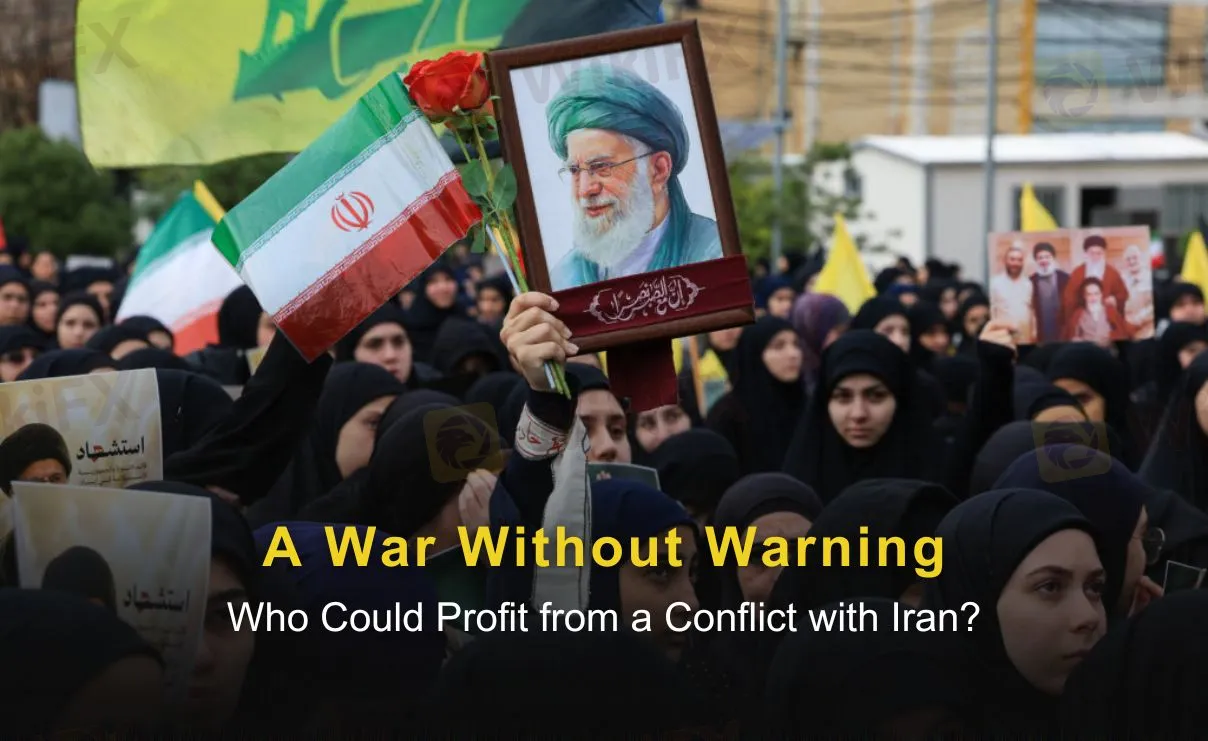
Over the past weekend, the United States launched military strikes against Iran, marking what could be the start of a new and deeply uncertain conflict in the Middle East. The decision has prompted urgent questions across diplomatic and financial circles: what immediate threat justified such action, and who ultimately stands to benefit?
The official explanations offered so far appear, at best, unconvincing. President Donald Trump has suggested that the strikes were necessary to address security concerns tied to Irans military and nuclear capabilities. Yet publicly available information does not appear to support the claim that Iran posed an imminent threat to the United States mainland.
The Missile Question
One justification floated in recent days has been the alleged risk of Iranian ballistic missiles capable of reaching American territory. However, Iran does not possess intercontinental ballistic missiles. There has been no verified evidence indicating that Tehran is close to acquiring such capability. Even US Secretary of State Marco Rubio recently acknowledged that any such development would be hypothetical and distant, rather than immediate.
Geography alone underscores the gap between rhetoric and reality. The United States and Iran are separated by thousands of miles. A strike on American soil would require advanced intercontinental technology that Iran is not believed to have.
The Nuclear Narrative
Attention has also turned to Irans nuclear programme. Claims have circulated that Tehran was on the brink of enriching uranium to weapons-grade levels. Yet no American or international intelligence body has publicly confirmed that Iran is currently engaged in industrial-scale enrichment for military purposes.
Indeed, Secretary Rubio stated during a press conference in Saint Kitts and Nevis that Iran was not enriching uranium at present. This directly contradicts suggestions that a nuclear breakout was imminent.
President Trump has previously asserted that earlier US military action had “totally obliterated” Irans nuclear programme. If taken at face value, that claim would appear inconsistent with the argument that the same programme now requires urgent military intervention.
Iranian officials, for their part, have repeatedly denied pursuing a nuclear bomb. While scepticism of Tehrans assurances is common in Western capitals, there has been no new publicly disclosed intelligence suggesting an immediate shift in policy.
Regime Change in Plain Sight
More strikingly, the president has signalled that the goal may extend beyond deterrence. In a pre-recorded message released shortly after the strikes, he indicated that the Iranian people should rise up against their government. Such language suggests that a long controversial and costly strategy could be the underlying objective.
If so, history offers sobering parallels. Iran is a nation of roughly 92 million people, more than triple the population of Iraq or Afghanistan at the outset of earlier US-led interventions. Both campaigns resulted in prolonged instability, significant loss of life and enduring regional consequences.
Irans internal power structure is also complex. Alongside its regular armed forces stands the powerful Islamic Revolutionary Guard Corps (IRGC), which controls extensive military, intelligence and economic networks. The IRGC has deep roots in domestic security and significant influence across key sectors of the economy. It is unlikely to dissolve simply because of external pressure or targeted strikes.
Reports from Iranian state media suggested that Supreme Leader Ayatollah Ali Khamenei was killed during the initial wave of attacks. Should that be confirmed, the succession process would not necessarily be swift or orderly. Unlike some political systems, there is no clear second-in-command poised to assume authority seamlessly. Any leadership vacuum could intensify internal power struggles rather than produce democratic reform.
A Digital Disconnect
If Washington genuinely intended to encourage popular uprising, observers note that certain preparatory steps appear absent. Communication infrastructure inside Iran remains heavily restricted. Internet shutdowns have limited the ability of citizens to organise or connect with the outside world.
At the same time, funding and staffing cuts to Farsi-language broadcasting platforms such as Voice of America have reduced the United States capacity to communicate directly with Iranian audiences. Without reliable channels of information, grassroots mobilisation becomes markedly more difficult.
The absence of a clear post-conflict roadmap has also raised concerns among policy analysts. Calls for security forces to surrender have not been accompanied by practical mechanisms outlining how such a transition might occur. Regime change, if that is indeed the aim, rarely unfolds spontaneously without careful planning and sustained engagement.
The Regional Equation
Given the uncertainties surrounding the stated objectives, attention naturally shifts to the question: who benefits?
Iran has longstanding rivalries with several Gulf Arab states, including Saudi Arabia, the United Arab Emirates and Qatar. These countries have often viewed Tehrans regional influence, from Iraq to Syria and Lebanon, as destabilising.
Heightened US pressure on Iran could align with their strategic interests. A weakened Tehran might reduce its capacity to project power across the region, potentially shifting the balance in favour of Gulf states.
Financial links further complicate perceptions. Qatar recently provided President Trump with access to a $400 million aircraft for official use, a gesture that drew scrutiny in Washington. Meanwhile, reports indicate that a significant cryptocurrency transaction involving entities in the United Arab Emirates directed billions of dollars into a Trump-affiliated venture. While no direct connection has been established between these financial dealings and military policy, the optics have prompted debate among ethics watchdogs and foreign policy experts.
Market Reverberations
For global markets, the escalation introduces fresh volatility. Oil prices have already shown signs of reacting to the prospect of disrupted supply routes through the Strait of Hormuz, a critical artery for global energy trade. Investors are closely monitoring shipping security, insurance costs and potential retaliatory measures by Tehran or its regional allies.
Currency markets in emerging economies may also feel pressure if energy prices spike or if geopolitical risk dampens investor appetite. Defence stocks, by contrast, could see gains amid expectations of increased military spending.
A War Without Consensus
Domestically, the move appears to diverge from earlier pledges to avoid foreign entanglements. During previous campaigns, President Trump portrayed himself as sceptical of regime change operations and prolonged overseas conflicts. The current strategy, if it is indeed aimed at reshaping Irans political order, represents a sharp departure from that stance.
Whether this escalation proves to be a limited show of force or the beginning of a broader confrontation remains uncertain. Much will depend on Irans response, the cohesion of its internal power structures and the willingness of regional actors to either restrain or inflame tensions.
For now, the rationale behind Washingtons decision remains contested. What is clear is that the consequences, be it strategic, economic and human, could extend far beyond the immediate theatre of operations. In geopolitics, as in finance, understanding who benefits is often the first step towards understanding why events unfold as they do.

Disclaimer:
The views in this article only represent the author's personal views, and do not constitute investment advice on this platform. This platform does not guarantee the accuracy, completeness and timeliness of the information in the article, and will not be liable for any loss caused by the use of or reliance on the information in the article.
WikiFX Broker
Latest News
New Zealand Dollar steady above 0.5900 as traders eye RBNZ, Fed
WikiFXPolish Zloty: Fiscal slippage and cautious NBP weigh – Commerzbank
WikiFXCanadian Dollar strengthens despite hawkish Fed rhetoric
WikiFXEuro strengthens against Canadian Dollar ahead of Germanys HICP data
WikiFXEuro: Limited downside, range defined against US Dollar – Scotiabank
WikiFXJapanese Yen: Supported below 160 against US Dollar – Scotiabank
WikiFXAustralian Dollar holds firm amid hawkish Fed and RBA expectations
WikiFXUSD/JPY Forecast: Retreats from one-month high but dip-buying eyed
WikiFXJapanese Yen: BoJ normalization expectations and contained moves – BNY
WikiFXForex Today: Attention shifts to US ISM, JOLTs and inflation in Europe
WikiFX