

Global Broker Regulation Inquiry App
About WikiFX
English
简体中文
繁體中文
English
Pусский
日本語
ภาษาไทย
Tiếng Việt
Bahasa Indonesia
Español
हिन्दी
Filippiiniläinen
Français
Deutsch
Português
Türkçe
한국어
العربية
اردو


The IBMP Scam: Thai Arrest Uncovers 18.8 Million Baht Fraud That Could Reach Malaysia

WikiFX
|


Abstract:Thai authorities have arrested a 22-year-old man suspected of playing a role in a large-scale online investment scam that deceived victims into placing money on a fraudulent stock-trading platform. The scheme, which operated through a mobile application known as “IBMP”, allegedly caused financial losses amounting to nearly 18.84 million baht.
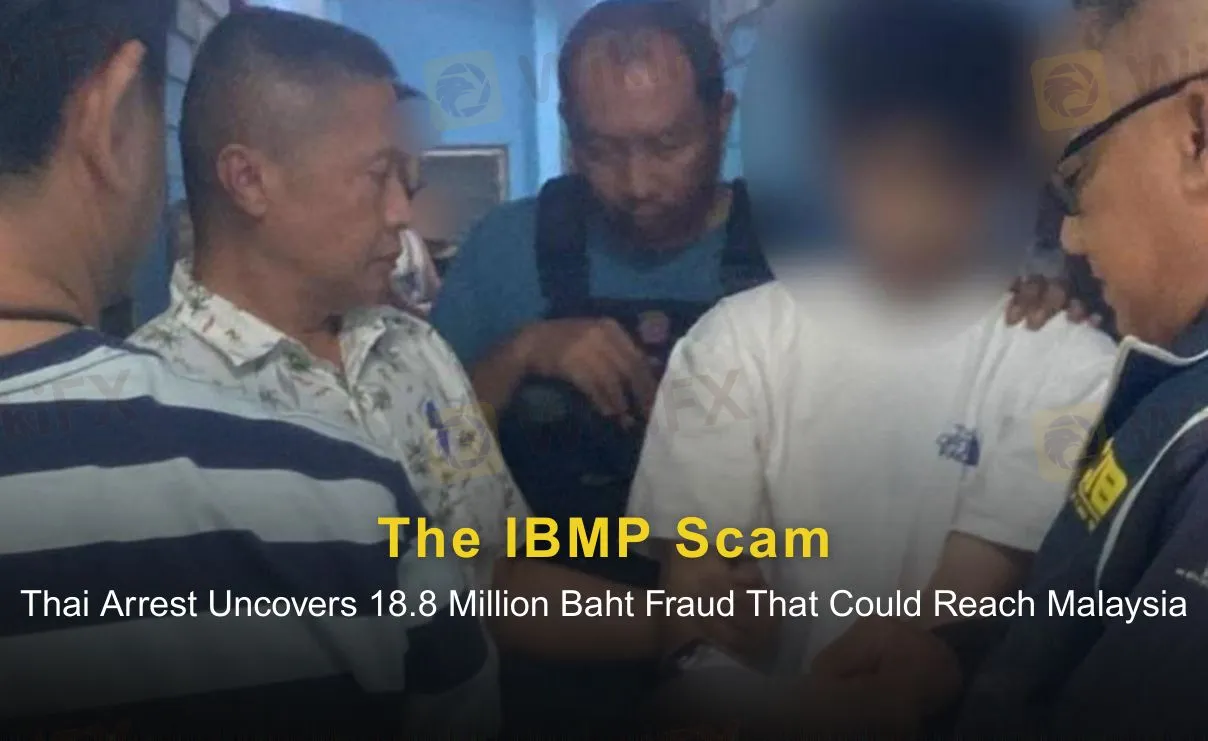
Thai authorities have arrested a 22-year-old man suspected of playing a role in a large-scale online investment scam that deceived victims into placing money on a fraudulent stock-trading platform. The scheme, which operated through a mobile application known as “IBMP”, allegedly caused financial losses amounting to nearly 18.84 million baht.
The suspect, identified by police as Phitakphong, was detained on Monday in soi Chaeng Watthana 17 in Pak Kret district, Nonthaburi province. The arrest was carried out by officers from Thailands Crime Suppression Division together with the Patrol and Special Operations Division, following an investigation led by the Central Investigation Bureau (CIB).
Arrest Linked to Fraud Investigation
Authorities confirmed that Phitakphong had been the subject of an arrest warrant issued by the Nakhon Ratchasima Provincial Court on 22 October last year. The charges include colluding in public fraud and importing false information into a computer system, offences commonly associated with online investment scams.
Investigators believe the suspect was part of a wider fraud network allegedly linked to Chinese organisers. According to police findings, the syndicate used social media platforms to promote investment opportunities through the IBMP mobile application, presenting it as a legitimate stock-trading service.
The advertisements targeted individuals interested in financial markets and promised professional guidance from experienced investment specialists. Potential investors were encouraged to deposit funds through the platform in order to begin trading.
How the IBMP Scam Operated
Authorities said the application was designed to mimic a genuine trading platform. It displayed fabricated trading activity and profit figures in users accounts, creating the impression that investments were performing well.
These simulated gains were intended to build confidence and encourage victims to deposit larger sums of money. However, once funds were transferred, investors reportedly found themselves unable to withdraw their profits or even access their original capital.
The fraud network allegedly responded to withdrawal requests by citing technical restrictions, regulatory procedures, or other administrative obstacles. As complaints mounted, victims began reporting the issue to law enforcement.
Investigators later confirmed that no real investment activity had taken place on the platform.
Money Funnelled Through Mule Accounts
Police reported that once victims transferred money into the system, the funds were quickly moved through a network of bank accounts held by intermediaries commonly known as mule accounts. These accounts are often used in fraud schemes to obscure the flow of money.
After being transferred through several accounts, the funds were withdrawn in cash and delivered to individuals believed to be coordinating the operation. Authorities suspect the money was ultimately handed over to senior members of the syndicate described as the groups Chinese organisers.
According to investigators, Phitakphongs alleged role in the operation involved collecting cash withdrawn from mule accounts before passing it further up the network.
Tracking Down the Suspect
Police began tracking the suspect after gathering evidence linking him to the fraud network. Investigators later discovered that he had been hiding in Chiang Rai province.
Authorities learned that he was planning to relocate to the Chaeng Watthana area in Nonthaburi province. Officers moved in to make the arrest before the relocation could take place.
During questioning, the suspect denied all allegations.
Police also revealed that Phitakphong is wanted under a separate arrest warrant issued by the Maha Sarakham Provincial Court for a similar offence, indicating possible links to additional fraud cases.
Following the arrest, he was transferred to investigators at Pho Klang Police Station in Nakhon Ratchasima province, where legal proceedings will continue. Authorities confirmed that the broader investigation into the syndicate remains ongoing.
Why Malaysian Investors Should Pay Attention
Although the case unfolded in Thailand, it carries important lessons for investors across Southeast Asia, including Malaysia. The two countries share close geographical proximity and strong cross-border economic connections. Fraud operations in one jurisdiction can easily expand their reach into neighbouring markets, particularly when scams are conducted online through mobile apps and social media advertising. For Malaysian investors, the incident serves as a reminder that suspicious investment platforms may originate from outside the country while still targeting local users. Maintaining vigilance, verifying the legitimacy of trading platforms, and relying on licensed financial services remain the most effective ways to avoid becoming the next victim of cross-border investment fraud.
As digital investment opportunities continue to grow across the region, regulators and law enforcement agencies face an ongoing challenge in combating increasingly sophisticated online scams. Cases such as the IBMP fraud illustrate how quickly fraudulent platforms can attract victims — and how difficult it can be to recover lost funds once they are transferred through complex financial networks.

Disclaimer:
The views in this article only represent the author's personal views, and do not constitute investment advice on this platform. This platform does not guarantee the accuracy, completeness and timeliness of the information in the article, and will not be liable for any loss caused by the use of or reliance on the information in the article.
WikiFX Broker
Latest News
Singapore tightens monetary policy in surprise move as rising oil prices rekindle inflation risk
WikiFXSPREDIX MARKETS Review: What Traders Should Know Before Depositing
WikiFXBXB Review – Zero Regulation, Dead Website: What Traders Need to Know
WikiFXHFM Review: No Regulatory Licences and a 1.83 Score , Is Your Deposit Safe?
WikiFXIs Your Withdrawal Plan Killing Your Compounding Gains?
WikiFXHFMARKETS TRADE Review: Zero Regulation and a Central Bank Warning
WikiFXWhy the Dollar Moves Almost Every Forex Pair
WikiFXChipmakers fall in US and Asia as AI jitters rattle investors
WikiFXBX Trade Review: Is This Unregulated Broker Worth the Risk?
WikiFXSTMARKET Review: Withdrawal Complaints Cloud a Low-Rated Broker, What to Know Before You Deposit
WikiFX