

Global Broker Regulation Inquiry App
About WikiFX
English
简体中文
繁體中文
English
Pусский
日本語
ภาษาไทย
Tiếng Việt
Bahasa Indonesia
Español
हिन्दी
Filippiiniläinen
Français
Deutsch
Português
Türkçe
한국어
العربية
اردو


She Lost RM13 Million in a Multi-Account Investment Scam with 26 Transfers

WikiFX
|


Abstract:A Hong Kong woman has lost more than HK$26 million, or RM13 million, after falling victim to a multi-account investment scam. But what exactly is a multi-account investment scam?
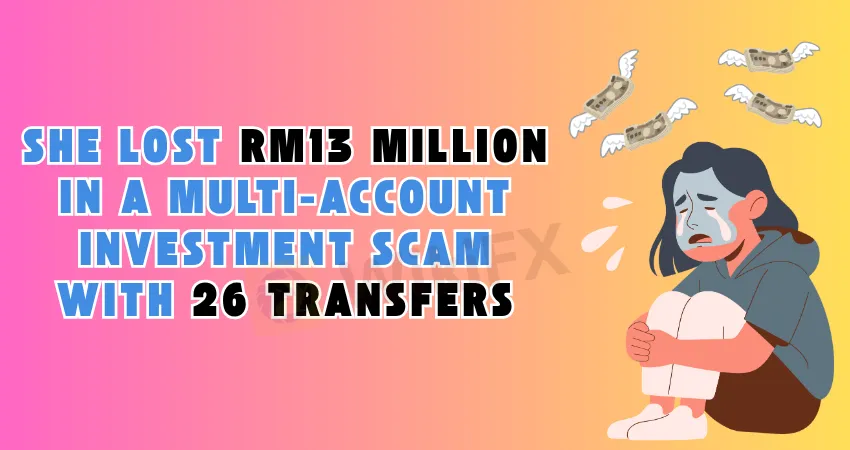
A Hong Kong woman has lost more than HK$26 million, or RM13 million, after falling victim to a multi-account investment scam.
According to police, the woman was first contacted on an online platform by a man who presented himself as an investment specialist. He later persuaded her to invest in shares through a popular messaging application, claiming to offer profitable opportunities.
The fraud began in November last year when the victim transferred HK$100,000 (RM50,000) into a bank account provided by the suspect. Over the following six months, she made 26 separate payments. Police said these included cash transfers totalling about HK$26 million, as well as a gold bar worth roughly HK$430,000 (RM216,800).
The money and assets were reportedly handed to 14 different individuals, a detail that has drawn attention to one of the clearest warning signs in investment fraud: repeated requests to send funds to multiple accounts or people.
After eventually realising she had likely been deceived, the woman reported the matter to police last Thursday. The case is being investigated as obtaining property by deception. No arrests have been announced.
 Contents
Why Multiple Accounts Are a Serious Warning Sign
Fraud investigators and industry specialists have long warned that changing payment instructions are rarely a normal business practice in regulated finance.
In a legitimate brokerage setting, clients usually deposit money into a segregated corporate account held under the brokers registered company name. These accounts are subject to anti money laundering controls, internal checks and regulatory oversight.
Scam operators often avoid this structure.
Instead, victims may be told to send money to personal accounts, unrelated third parties or newly introduced bank accounts. Fraudsters may claim the changes are needed for tax payments, faster withdrawals, account upgrades or temporary liquidity needs.
Such requests are often part of a strategy designed to hide where the money goes.
How the Tactic Works
The process commonly follows three stages.
First, the victim is asked to make an initial deposit into what appears to be the brokers official account. In many cases, that account belongs to another person acting on behalf of the fraud network.
Second, further payments are requested under new reasons. These may include trading margin top ups, legal charges, withdrawal fees or tax clearance costs. Each payment is directed to a different account.
Third, once funds are received, they are moved quickly across several accounts, sometimes across borders. This makes tracing the money far more difficult and reduces the chances of recovery.
By the time victims become suspicious, the trail is often hard to follow.
Why Regulated Brokers Do Not Operate This Way
Properly authorised brokers are expected to maintain clear and transparent payment systems.
They are generally required to keep client funds separate from company money, use accounts in the firms legal name, verify customers through Know Your Customer procedures and follow anti money laundering rules.
Frequent changes to payment instructions would likely trigger compliance concerns from regulators and banking partners. Requests to send money to personal accounts or unrelated third parties would be highly unusual in most regulated markets.
In practical terms, investors should question any broker that cannot provide a clear corporate account matching its legal entity.
Risks Beyond Losing Money
Sending funds through multiple accounts can create further problems beyond the immediate financial loss.
Recovery efforts become harder because the payment trail is fragmented. Banks may reject chargeback claims if transfers were made voluntarily. Cross border payments can create legal complications, while funds may be converted into cryptocurrency or moved offshore without the investors knowledge.
In some cases, victims may even become linked to accounts later examined in money laundering investigations.
What Investors Should Do
If a broker asks for payments to different accounts, especially those under personal names, investors should stop immediately and verify the request.
They should ask for formal documentation, confirm whether the broker is licensed by a recognised regulator, and compare the account name with the companys registered legal entity. Contacting the bank promptly can also be critical if money has already been sent.
Growing Need for Due Diligence
As online trading becomes more popular, checking a brokers regulatory status, history and user feedback is increasingly important. Research platforms such as WikiFX, which track broker profiles, licences and risk alerts, can help investors identify suspicious operators before funds are transferred.
For investors, the lesson is simple: if payment instructions keep changing, the real risk may have already begun.
Disclaimer:
The views in this article only represent the author's personal views, and do not constitute investment advice on this platform. This platform does not guarantee the accuracy, completeness and timeliness of the information in the article, and will not be liable for any loss caused by the use of or reliance on the information in the article.
WikiFX Broker
Latest News
Malaysia’s Pension Fund (KWAP) Hit by eFishery Fraud Scandal with RM163 Million at Risk
WikiFXEMAR MARKETS Review 2026: FSCA Regulation, Withdrawal Complaints, and Account Access Risks
WikiFXFacing a 20% Floating Loss: How Beginners Can Prevent a Margin Call
WikiFXInstaForex Review 2026: Is This Forex Broker Safe?
WikiFXSandStoneFX Review 2026: Is This Forex Broker Safe?
WikiFXFake Investment Scam and Human Trafficking Network Busted with 109 Arrested
WikiFXForex Traders With Day Jobs: The PERKESO Deadline You Cannot Ignore
WikiFXMaxpro365 Review 2026: Where Is My $23,000? We Investigated User Allegations About Missing Funds
WikiFXHow Trading Costs Quietly Drain Your Account: Spreads, Swaps, and Pip Values
WikiFXWhy MetaTrader 4 Remains the Top Choice for Testing Automated Trading Robots
WikiFX