


Global Broker Regulation Inquiry App
About WikiFX
English
简体中文
繁體中文
English
Pусский
日本語
ภาษาไทย
Tiếng Việt
Bahasa Indonesia
Español
हिन्दी
Filippiiniläinen
Français
Deutsch
Português
Türkçe
한국어
العربية
اردو
Revenge Trading in Forex: Why Chasing Your Losses Costs You More
Abstract:Revenge trading happens when a trader loses money and immediately opens new, riskier positions out of frustration to win it back. Driven by loss aversion and the sunk cost fallacy, this emotional reaction forces you to abandon technical analysis and fight the market. Recognizing when you have lost control is the first step to protecting your capital.
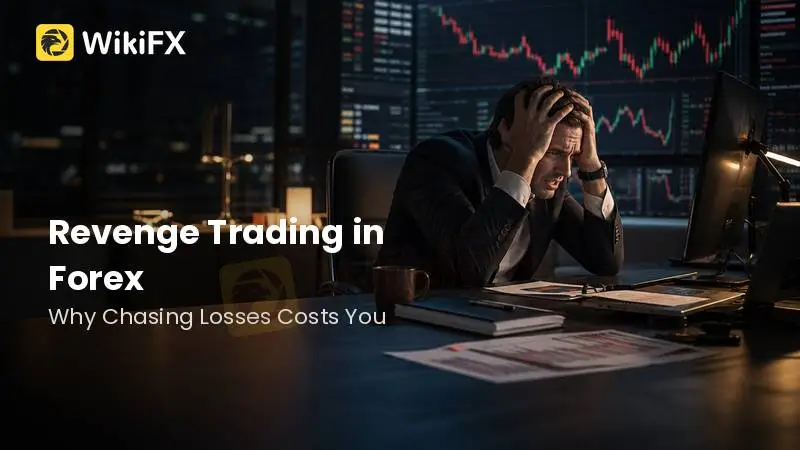
Many beginners in Malaysia experience this familiar cycle: you set up a trade, the market reverses, and your stop-loss gets hit. You feel frustrated and cheated. Instead of stepping back to analyze what went wrong, you immediately open a new position—often with a bigger lot size—just to win that money back.
In Forex, this is called “revenge trading.” It happens when you stop trading based on strategy and start trading based on anger. Rather than reading the market, you are trying to punish it. Here is why this behavioral trap happens and how to recognize when you have lost control.
 Contents
The “Tit for Tat” Trap: Why We Fight the Market
In economics, there is a strategy called “tit for tat,” which describes how humans interact in competitive environments. The concept is simple: if an opponent hits you, you retaliate and hit them back. In business negotiations or social settings, this kind of retaliation can sometimes force the other side to cooperate.
However, applying this mindset to the Forex market is a disaster. The market is not a person. It does not know you, it does not care about your account balance, and it cannot be punished. When you lose a trade and immediately try to retaliate by forcing a new order, you are not hitting the market back—you are only fighting your own capital.
The Sunk Cost Fallacy and Loss Aversion
Why is it so hard to simply accept a losing trade and move on? Behavioral economics explains this through the “sunk cost fallacy.” A sunk cost is a loss of money, time, or effort that you cannot get back. Rational decision-making says that sunk costs should not affect your future choices. If you lost $50 on a bad trade, that money is gone.
Unfortunately, human beings naturally suffer from “loss aversion.” We feel the pain of losing money much more intensely than the happiness of making money. When you close a trade at a loss, you feel a strong psychological urge to erase that pain immediately. This failure to acknowledge a loss causes traders to dig their heels in deeper, pouring more margin into failing setups just to prove their original idea was right.
Trading on Anger Instead of Market Sentiment
Professional technical analysis relies on observing market sentiment—whether the broader crowd of investors is bullish or bearish. Successful traders use moving averages, chart patterns, and price action to anticipate where the market is going based on actual supply and demand.
A revenge trader completely ignores real market sentiment. When you are rushing to recover a loss, you stop looking at objective data. Your only indicator becomes your own frustration. You start buying simply because you want the price to go up, assuming that a market must reverse soon just because it has already dropped so much. This is a dangerous illusion.
How to Tell When You Have Lost Control
How do you know if you are executing a valid new setup or if you are just revenge trading? The easiest way to check your own psychology is to ask yourself one question before you click buy or sell:
Would I take this exact trade right now if I had not just lost money on the previous one?
If the answer is no, you are trading on emotion. Other clear signs that you have lost control include:
- Increasing your lot size: You double your leverage hoping to recover your losses in a single price swing.
- Abandoning your limits: You enter a trade without setting a stop-loss because you “know” the price will bounce back.
- Feeling physical urgency: You feel a tight chest, a racing heart, and a desperate fear of missing out on the next candle.
The Practical Takeaway
The only way to beat the sunk cost fallacy is to set strict daily limits and walk away when they are reached. If you lose two trades in a row, close your laptop. Focus on the returns of your future trades, not the money you spent in the past.
Sometimes, frustration comes from outside factors, such as sudden spread widening or execution delays that constantly stop you out. If you suspect your trading environment is unfair, do not keep throwing money at the problem. Take a step back and use the WikiFX app to check your brokers regulatory license and read user reviews. Ensuring you are trading with a verified, trustworthy broker gives you the peace of mind to focus entirely on what actually matters: managing your own psychology.

Disclaimer:
The views in this article only represent the author's personal views, and do not constitute investment advice on this platform. This platform does not guarantee the accuracy, completeness and timeliness of the information in the article, and will not be liable for any loss caused by the use of or reliance on the information in the article.
WikiFX Broker
Latest News
OROKU EDGE Review 2026: Blacklist Warnings, Withdrawal Complaints, and High Leverage
 WikiFX
Reading the Market Weather: How to Identify Forex Trends and Ranges
WikiFXUsing Volatility and ATR to Fix Your Forex Stop Loss
WikiFXIs It Your Fault for Falling for an Investment Scam?
WikiFXPIPS STAR Review 2026: Unregulated Status and What Indian Traders Should Check
WikiFXHousewife Loses RM250,000 Life Savings to Ghost Investment Scheme Promising 10% Returns
WikiFXDeltaFX Review 2026: My MT5 Account Was Locked During Trade. Did the Trader Lose Everything?
WikiFXCan AI Really Improve Forex Trading? The Benefits, Risks and Hidden Limitations
WikiFXStoneX Review 2026: Should You Trade with This Broker?
WikiFXYen Firms While Dollar Pauses
WikiFXCurrency Calculator
USD

CNY
Current Rate:0
Enter amount
USD
Redeemable Amount
CNY
Calculate 