Abstract:Dalal Street gap-up on Iran-US peace hopes and crude crash has traders divided between a 1,500-point rally and a classic bull trap — here is what the data actually says.
The Gap-Up That Has Everyone Either Celebrating or Sweating
So Nifty decided to wake up on Monday morning like that one overconfident relative who shows up to a family function two hours early — loud, dramatic, and absolutely convinced he is the hero of the day. The index gap-up opened near 23,940, traders started doing mental calculations about EMI prepayments, and Twitter went from zero to 'bookmark this' in about four minutes flat. One @Realrohitsharma was already screaming about a 1,000 to 1,500 point move in Nifty — bhai, the confidence of this man could launch a rocket. But before you mortgage your wife's gold jewellery to buy call options, let us actually look at what is happening.
Why Did the Market Gap Up? The Iran-US Fairy Tale
The trigger for Monday's euphoria is a potential Iran-US peace deal, which has sent crude oil crashing more than 4.7 per cent. For India — a country that imports roughly 85 per cent of its crude oil — this is genuinely good news. Every one-dollar fall in Brent crude saves India approximately Rs 10,700 crore annually in import bills. Lower crude means lower inflation, a stronger rupee, fatter margins for paint companies, airlines, tyre makers, and every logistics firm that burns diesel for breakfast. GIFT Nifty was trading near 23,970 before the open, signalling a positive start, and Bank Nifty crossed its 50-day moving average — which, for the technically inclined, is not a small thing. Over 85 per cent of midcap and smallcap stocks were in the green, which means this was not just a two-stock circus; the buying was broad-based.
The 24,000 Level: Why This Number Is Not Just Astrology
Now, let us talk about the 24,000 level, which has become the Lakshman Rekha of this market. Multiple traders and analysts pointed out that call writers — the big money, the serious players — were actively writing 23,800 and 23,900 calls, meaning they were essentially betting that the market would NOT sustain above those levels. When the market gaps above a zone where call writers are positioned, those writers are forced to cover, which creates buying pressure. That mechanical buying can look like genuine momentum when it is actually just a short squeeze in a fancy suit. @KavishreeWealth put it cleanly: if buyers do not take control back at 24,000 and hold it convincingly, the gap-up itself becomes a trap for every excited retail trader who bought at the open. The consolidation range being watched was 23,920 to 24,070, and within that band, the market was essentially doing nothing except giving traders anxiety.
Bull Trap Warning Signs You Cannot Afford to Ignore
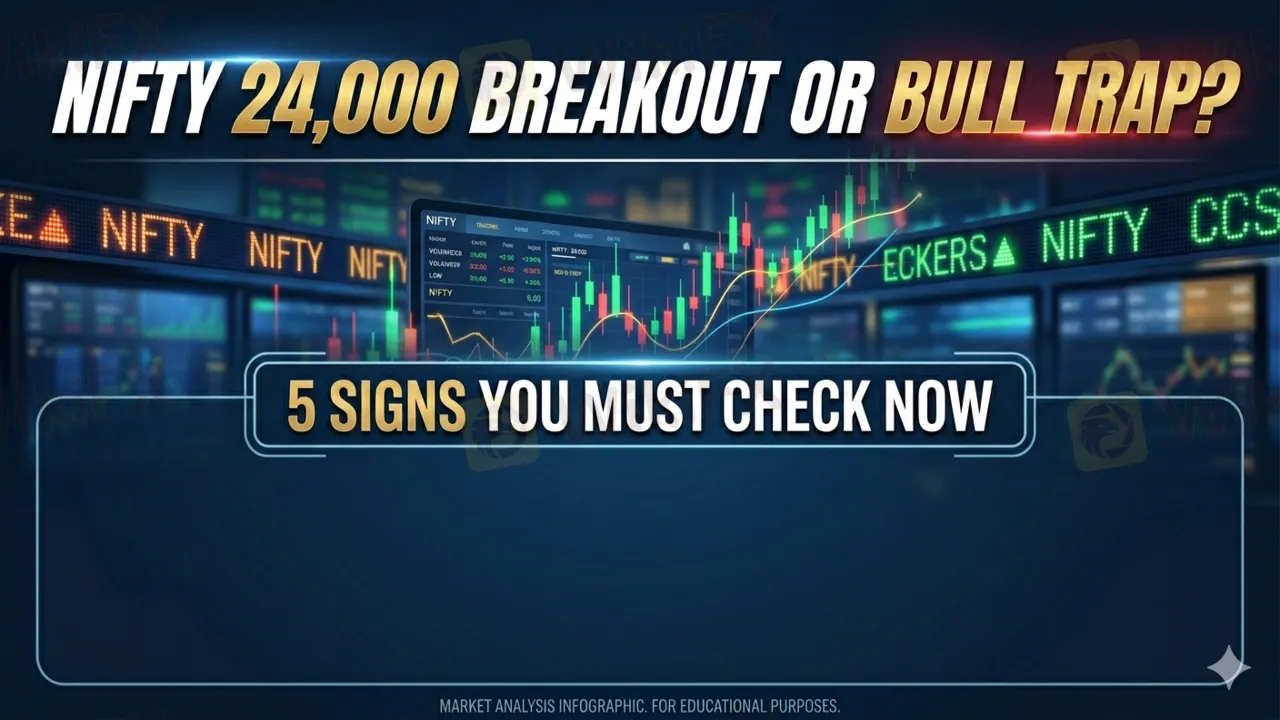
Here is where we separate the informed from the impulsive, yaar. First sign of a potential trap: Nifty touched a high of 23,987 during the session but could not close above 24,000 with conviction. As @arbindtiwariT noted, the index was not showing the power it needed to show near resistance. Second sign: option chain data suggested the market was range-bound between 23,920 and 24,070 — not exactly the setup for a runaway rally. Third sign: the geopolitical catalyst is a 'potential' peace deal, not a signed treaty. Markets have been burned before by Middle East optimism that evaporated faster than a WhatsApp rumour. Fourth sign: we are near expiry — rollover of F&O positions to the June series is urgent, and expiry weeks are notoriously prone to whipsaw moves designed to destroy both bulls and bears simultaneously. Fifth sign: if crude oil bounces back even slightly, the entire thesis falls apart like a house built on borrowed margin.
What the Smart Money Is Actually Watching
The traders who have been around long enough to have grey hair and emotional scars are watching three specific things this week. One: Does Nifty not just touch 24,000 but close above it on a daily chart with volume confirmation? Touching a level and closing above it are as different as flirting and getting married. Two: FII activity — foreign institutional investors have been the swing factor all year, and their buying or selling in the cash market will tell you whether this rally has real legs or is just DIIs doing their patriotic duty again. Three: Bank Nifty needs to clear the 54,400 to 54,600 resistance zone convincingly; if it does, targets of 55,250 to 55,700 become realistic. If it fails, the entire market structure weakens. The broader technical picture is actually not bad — Friday's session formed a bullish candle, the hourly chart shows a higher-high, higher-low formation, and the 50-day SMA has been reclaimed. These are not signs you dismiss.
The 'Most Hated Rally' Theory and Why It Might Be Right
Here is the uncomfortable truth that the bears do not want to hear. @Darshanj101, invoking what he calls a 'pro astro view' — which, look, we are not endorsing financial astrology, please do not come for us — made a point that is actually grounded in market psychology: the biggest rallies are always the most doubted in the beginning. When everyone is calling a bull trap, when every second Twitter thread is screaming 'gap-up will fade', that wall of worry is precisely the fuel that the best rallies climb. If 90 per cent of retail traders are scared to buy, who exactly is left to sell? This does not mean you throw risk management out the window and go all-in on weekly calls. It means you respect both scenarios — the breakout AND the trap — and you have a plan for each. Your stop loss is not a suggestion; it is the only thing standing between you and a very uncomfortable conversation with your family about 'where the savings went.'
The Bottom Line: Respect the Level, Respect the Risk
Nifty at 24,000 is not a guaranteed jackpot, and it is not a guaranteed disaster — it is a decision point, and the market will make its verdict known through price action, not through Twitter polls or Telegram signal groups. The macro setup — falling crude, easing geopolitics, broad-based buying, Bank Nifty above its 50-DMA — is genuinely constructive. But the 24,000 level has rejected the index before, call writers are positioned for pain above it, and expiry week volatility can make even the best setups look stupid. Trade with defined risk, roll over your open F&O positions to June immediately, and please — for the love of everything holy — do not take position sizing advice from anyone whose profile picture is a Lamborghini. The market will still be here next week. Make sure your capital is too.
#Nifty50 #DalalStreet #BullTrap #NiftyBreakout #StockMarketIndia #BankNifty #FnO #IndianMarkets #SEBI #CrudeOil
For the latest forex updates, download the WikiFX App today.

Other Interesting Articles for You
ECN vs STP Forex Brokers: A Complete 2026 Comparison
If you've spent any time researching forex brokers, you've almost certainly run into the labels ECN and STP. They sound technical, broker marketing departments use them interchangeably, and the actual difference matters more for your trading costs than most beginners realize.
Both ECN and STP are No Dealing Desk (NDD) execution models — neither broker type takes the opposite side of your trade. That alone separates them from market makers and matters because it removes a fundamental conflict of interest. But the way each model routes your order, prices it, and earns revenue is structurally different, and those differences directly translate into the spread you pay, the slippage you absorb, and whether your strategy is profitable at scale.
This guide breaks down exactly how the two models work, where they diverge, and which one fits which type of trader.
News
2026-05-20
Further Reading