


Global Broker Regulation Inquiry App
About WikiFX
English
简体中文
繁體中文
English
Pусский
日本語
ภาษาไทย
Tiếng Việt
Bahasa Indonesia
Español
हिन्दी
Filippiiniläinen
Français
Deutsch
Português
Türkçe
한국어
العربية
اردو
How to Run a Weekend Review Using Your Trade Blotter
Abstract:A weekend review of your trading history, known in the financial industry as a trade blotter, is one of the most effective ways to spot recurring mistakes. This article explains what a trade blotter is, how professionals use it to audit performance, and how beginners can use their broker's software to evaluate their weekly gains and losses.
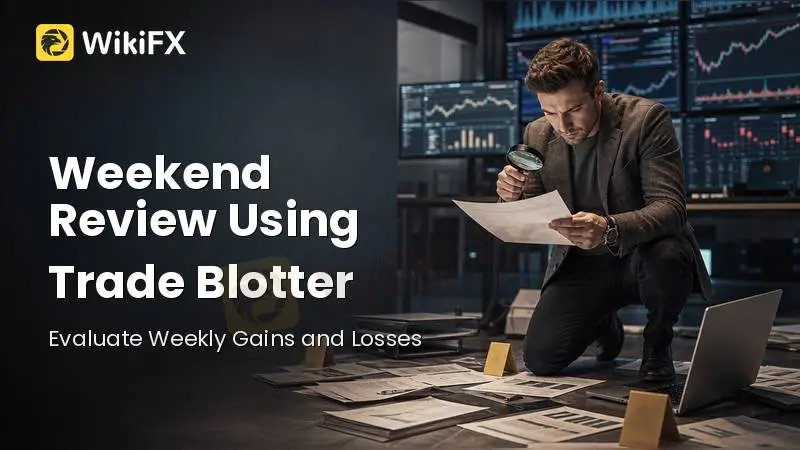
On weekends, the Forex market is closed. The charts stop moving, the prices freeze, and you finally have a moment to breathe. For many beginner traders in Malaysia, Saturday and Sunday are days to forget about the market entirely. But if you find yourself constantly entering trades at the wrong time or repeating the same stressful mistakes, the weekend is actually the best time to figure out why.
To do this, you do not need complex analytical tools. You just need to open your closed trading software and look at a record that financial professionals call a “trade blotter.”
 Contents
What Exactly Is a Trade Blotter?
A trade blotter (sometimes called a deal blotter) is a detailed, organized record of all the trades you have made over a certain period of time. If you use common Forex trading software provided by your broker, you already have a digital blotter built into the platform—it is usually found in your “Account History” tab.
This record does not care about your emotions; it simply documents the hard facts. A standard trade blotter logs the exact time of your trade, the currency pair being traded, the unit price, and the total quantity or lot size (the volume of your trade). Crucially, it records whether the order was a buy or sell, the settlement date, and even orders that you entered but canceled before they were filled.
While old-school traders used to write these details down on large paper spreadsheets, todays digital blotters automatically record your trades through a broker's data feed, allowing you to easily sort and evaluate your positions at the end of the day or week.
Why Regulators and Pros Care About the Data
Understanding how big institutions use blotters can change how you view your own trading history. In the corporate finance and investment world, a trade blotter is legally required.
Compliance departments and regulatory agencies, such as the Securities and Exchange Commission (SEC) in the US, use these detailed records during audits. They sort through blotters by investment type to detect illegal activity, such as insider trading before major news events, or to see if a broker is showing favoritism to certain high-commission client accounts.
A blotter can also expose an institutional portfolio manager who claims to use a safe, long-term strategy but is secretly executing risky, short-term trades. Regulators look at the data to find discrepancies. Retail traders should use the exact same logic to audit themselves.
Step-by-Step: Evaluating Your Weekly Gains and Losses
When your trading app is closed for the weekend, you have a perfect opportunity to use your blotter to evaluate your weekly performance. Memory can be deceiving when money is on the line, but your trading history reveals the honest truth about your trading habits.
Here is how you can use your blotter to spot costly mistakes:
Check your timing on entries and exits
Look at the specific execution times logged in your blotter. Are your losing trades always happening precisely during volatile news releases when spreads (the varying gap between buy and sell prices) suddenly widen? Pinpointing these times helps you realize if you are trading during conditions you do not actually understand.
Audit your order sizes
Review the quantity column on your trades. Did you mostly trade safe, small sizes from Monday to Thursday, only to suddenly triple your lot size on a Friday night to recover a loss? A blotter will clearly highlight these emotional spikes in risk.
Analyze canceled orders and hesitation
If your blotter shows a mix of canceled orders or constantly moving exit points, it is a sign that you lacked confidence in your trading plan. Sorting through these moments allows you to see where you were reacting out of fear rather than following a strategy.
Instead of constantly searching for new market signals, spend your weekend reviewing the data you have already generated. Your trade blotter will show you exactly where you need to improve before the market opens again on Monday.
As a final practical takeaway, a trade blotter is only useful if the data is accurate and your broker is executing your trades fairly. While you are taking the time to audit your weekly trades, you can use the WikiFX app to quickly check your broker's regulatory background. Verifying that your broker holds valid licenses ensures you are reviewing legitimate market data on a secure platform.

Disclaimer:
The views in this article only represent the author's personal views, and do not constitute investment advice on this platform. This platform does not guarantee the accuracy, completeness and timeliness of the information in the article, and will not be liable for any loss caused by the use of or reliance on the information in the article.
WikiFX Broker
Latest News
EMAR MARKETS Review 2026: Complaints, High Leverage, and Withdrawal Risk Signals
 WikiFX
EMIRAX MARKETS Review 2026: Unregulated Status, High Leverage, and Withdrawal Complaints
WikiFXHow the Bullet Theory Fixes the Habit of Overtrading
WikiFXReview 2026: Interactive Brokers Regulation, Complaints, and Platform Access
WikiFXReview 2026: STMARKET Regulation, MT5 Access, and Withdrawal Complaint
WikiFXOver 100 Malaysian Retirees Gather to Expose How Investment Scams Wiped Out Their Life Savings
WikiFXSquaredFinancial Review 2026: Heavy Complaints, Withdrawal Delays, and Profit Deletions
WikiFXUbuntu Invest Review 2026: Is This Forex Broker Safe?
WikiFXVonway Forex Review 2026: Withdrawal Complaints, Regulation Warnings, and Account Risks
WikiFXStructuring a Practical Forex Trading Plan and Stop-Loss Strategy
WikiFXCurrency Calculator
USD

CNY
Current Rate:0
Enter amount
USD
Redeemable Amount
CNY
Calculate 