Abstract:Backtesting remains one of the primary skills forex traders learn. By implementing a trading strategy based on historical currency pair price information, traders can view their past performance. The strategy leading to consistent profits during backtesting can raise confidence and lay a structured approach to the forex market. However, the path is not as simple as it may sound. Several traders tend to meet a harsh reality when transitioning to live trading. The strategy that seemed almost flawless on historical charts suddenly fails to deliver the results it did before.
The sudden difference may not necessarily be because of a poor strategy. Rather, it indicates limitations concerning backtesting and several factors that play their part in a live market where conditions change frequently. It is thus important to understand these differences so that you can set realistic expectations and work on to achieve consistent success.
Backtesting remains one of the primary skills forex traders learn. By implementing a trading strategy based on historical currency pair price information, traders can view their past performance. The strategy leading to consistent profits during backtesting can raise confidence and lay a structured approach to the forex market. However, the path is not as simple as it may sound. Several traders tend to meet a harsh reality when transitioning to live trading. The strategy that seemed almost flawless on historical charts suddenly fails to deliver the results it did before.
The sudden difference may not necessarily be because of a poor strategy. Rather, it indicates limitations concerning backtesting and several factors that play their part in a live market where conditions change frequently. It is thus important to understand these differences so that you can set realistic expectations and work on to achieve consistent success.
 Contents
Backtesting Shows Historical Results, But That May Not Replicate Live Market Conditions
Historical charts remain static. So, as you review the past market data, you already figure out the completion of the price movement. This allows for a more seamless trade setup identification in the absence of any uncertainty. You will find complete candles, visible trends and obvious support and resistance levels. However, live trading is entirely different. Every new candle you see brings uncertainty. Traders need to make decisions without being assured of the outcome. Backtesting fails to reveal the fear of losing capital, excitement after continuous trade wins, or frustration following consecutive losses. Traders with profitable strategies can also forego their trading plans due to emotions that do not prevail during historical testing.
Dynamic Market Conditions Will Always Challenge Backtesting Results
Markets do not remain the same; they keep changing based on several fundamental and technical factors. So, the strategies that worked during a trending market may fail to deliver during range-bound or volatile trading. Backtesting generally applies to specific past timeframes that may not align with existing market conditions. Lets understand it with an example. Suppose you tested a strategy during periods demonstrating strong directional movement. However, it may lead to disappointing results during low-volatility periods. Successful traders fully understand that no single strategy delivers equal results in every market environment. They instead evaluate and adapt with the evolving market conditions.
So, How is Real Trading Different?
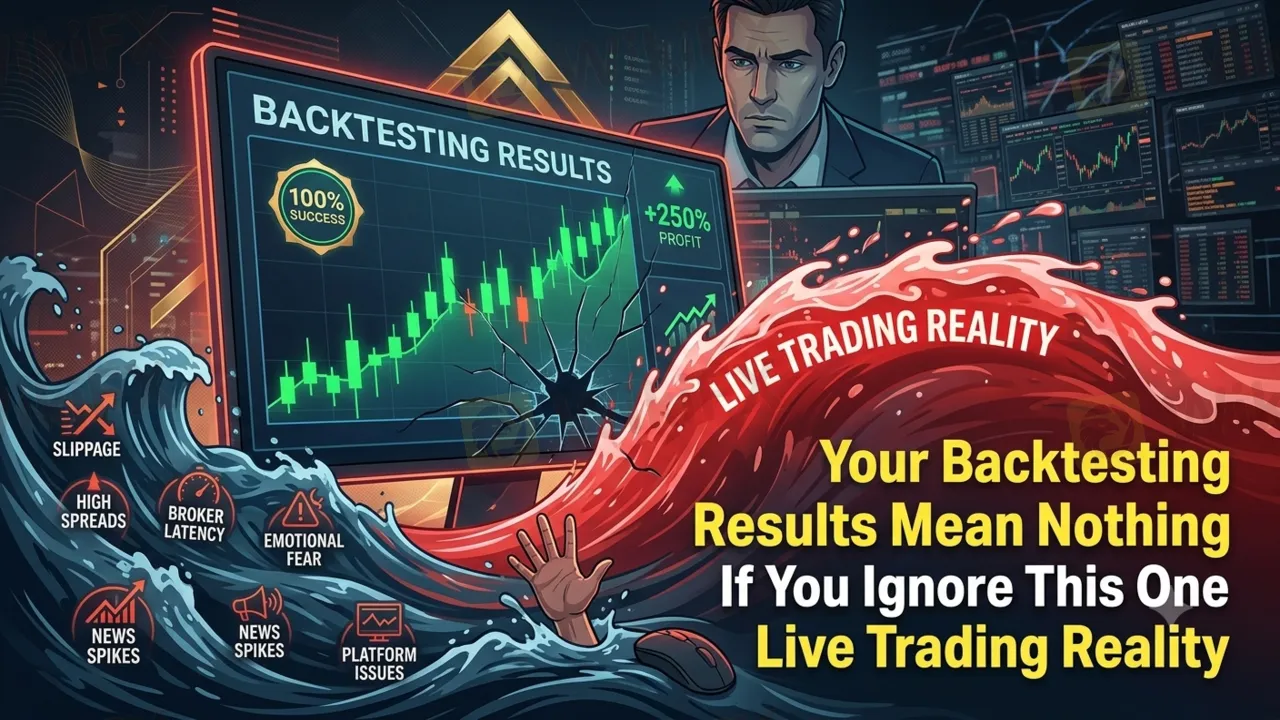
Backtesting comes with a clear flaw of assuming the execution of every trade at the intended price. This is where live markets bite many traders following this strategy. In a live market, there is no denying many undesirable outcomes that can influence trade order execution. Some of these are shown below:
- Slippage during a volatile market
- Variable spreads during major news announcements
- Delayed execution of trade orders
- Partial fills on some order types
- Platform or Internet issues
Psychological Pressure Can Make a Difference
Psychology is one of the biggest gaps between backtesting and live trading. There is no financial risk during backtesting. There is no emotional weight attached with losing trades because of no real capital involvement. However, as the focus shifts to live trading, emotional triggers begin to affect decision-making. As a result, traders may:
- Close winning trades too quickly out of fear.
- Move stop-loss orders to resist losses.
- Increase position sizes following consecutive gains.
- Revenge trade following a spell of losses.
- Feel reluctant to enter valid setups.
These tendencies can drastically change the performance of a variable profitable trading strategy.
Backtesting May Lead to False Confidence
Many beginner traders try to optimize a strategy until it performs perfectly on historical data. This process leads to a strategy customized to past price movements compared to future market behavior.
Such an over-optimized system often leads to impressive historical returns. However, it performs poorly in real markets because future price action never follows the past.
Traders should instead take time to build robust trading strategies to deal with different market conditions.
Risk Management is More Important Than Historical Returns
Backtesting often makes traders focus on profit numbers while ignoring risks. A strategy may deliver outstanding returns but witness massive drawdowns that many traders can find it hard to deal with in a live market. Professional traders not only focus on maximizing profit; they also factor in:
- Maximum Drawdown
- Win Rate
- Average Risk-to-Reward Ratio
- Consecutive Losing Trades
- Consistency Across Different Market Conditions
Evaluating these metrics helps these traders gain a more realistic view of a strategy fit for live trading.
Final Thoughts
Backtesting remains an essential step in developing any Forex trading strategy. It helps traders understand market behavior, identify potential opportunities, and build confidence in their trading approach. However, historical performance should never be viewed as a guarantee of future success.
Live trading introduces emotions, execution challenges, changing market conditions, and psychological pressures that cannot be fully replicated through backtesting. The most successful traders combine thorough backtesting with forward testing, disciplined risk management, and continuous learning.
By recognizing the limitations of historical testing and preparing for the realities of live markets, traders can make a smoother transition from theory to practical trading while improving their chances of achieving consistent long-term results.
Download the WikiFX app for more forex trading insights.

Interesting Articles for You