

Global Broker Regulation Inquiry App
About WikiFX
English
简体中文
繁體中文
English
Pусский
日本語
ภาษาไทย
Tiếng Việt
Bahasa Indonesia
Español
हिन्दी
Filippiiniläinen
Français
Deutsch
Português
Türkçe
한국어
العربية
اردو


Forest City Scam Raids Raise Fresh Warning for Malaysian Property Owners

WikiFX
|


Abstract:Malaysia's Forest City has long been associated with empty towers, quiet streets and an ambitious property project that failed to attract the hundreds of thousands of residents originally envisioned. Now, the development is facing a different kind of scrutiny after police raided two suspected scam operations operating from its residential properties. The recent raids esulted in the arrest of 335 people and the seizure of assets estimated at about RM1 million, including 313 computers, 1,557 mobile phones, 17 laptops and 10 modems. Police said the two operations were spread across 32 premises in Forest City.
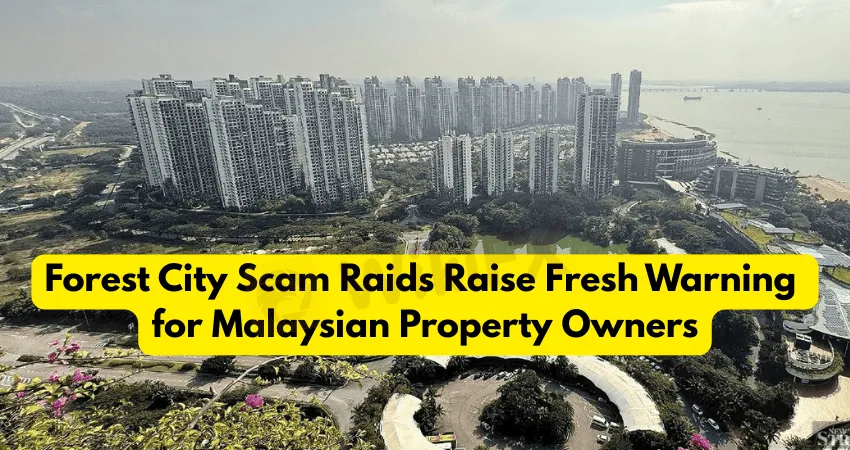
Malaysia's Forest City has long been associated with empty towers, quiet streets and an ambitious property project that failed to attract the hundreds of thousands of residents originally envisioned. Now, the development is facing a different kind of scrutiny after police raided two suspected scam operations operating from its residential properties.
The recent raids esulted in the arrest of 335 people and the seizure of assets estimated at about RM1 million, including 313 computers, 1,557 mobile phones, 17 laptops and 10 modems. Police said the two operations were spread across 32 premises in Forest City.
According to police, the two alleged operations were involved in cryptocurrency investment and romance scams targeting victims overseas. One call centre reportedly occupied 27 apartments across five floors of a residential tower, while another operated from five bungalows.
Those arrested included 309 Chinese nationals, 19 Indonesians, three Malaysians and four Myanmar nationals. Johor police said investigations were continuing, with cooperation from INTERPOL to identify the alleged mastermind behind the operations.
From luxury development to suspected scam hub
Forest City was launched in 2016 by Chinese developer Country Garden and Malaysian partner Danga 88. The project was promoted as a futuristic, environmentally friendly city near Singapore, with plans to accommodate about 700,000 people across a vast artificial island.
The 14-square-kilometre development remains sparsely populated, with estimates suggesting that fewer than 1% of the planned population currently lives there. Only around 15% to 20% of the originally proposed development is understood to have been completed.
The project's difficulties have been linked to several factors, including the Covid-19 pandemic, China's property crisis and restrictions on borrowing and overseas property purchases by Chinese citizens.
For investors, the consequences have been visible in the form of vacant apartments, quiet commercial areas and unfinished infrastructure. Those same conditions may now have created an opportunity for criminal groups.
Malaysian authorities have also previously uncovered scam centres operating from condominiums and bungalows in Johor, Penang and Kuala Lumpur. The latest operation suggests that criminal groups may continue to adapt their locations and methods despite repeated enforcement actions.
In investment scams, victims are often promised high returns and encouraged to transfer money or cryptocurrency through platforms controlled by the fraudsters. Romance scams use a different approach but can lead to the same outcome, with criminals building relationships before introducing financial requests or fake investment opportunities.
Malaysian consumers are already familiar with both types of fraud. The Forest City case shows that the people operating such schemes may themselves be part of sophisticated international networks rather than small groups working independently.
A warning for Malaysians
For Malaysian investors, the broader lesson is to separate the appearance of legitimacy from evidence of regulation and financial credibility. Investment opportunities promoted through social media, messaging applications or overseas contacts should be independently verified before money or cryptocurrency is transferred.
As Malaysia continues to develop its digital economy and position itself as a regional financial and technology hub, authorities face the challenge of ensuring that the country's infrastructure is used for legitimate commerce rather than becoming a base for increasingly professionalised global fraud networks.
Disclaimer:
The views in this article only represent the author's personal views, and do not constitute investment advice on this platform. This platform does not guarantee the accuracy, completeness and timeliness of the information in the article, and will not be liable for any loss caused by the use of or reliance on the information in the article.
WikiFX Broker
Latest News
Rupee Holds Near 95.70 as RBI Support Meets Oil Risk
WikiFXEMIRAX MARKETS Review: Withdrawal Blocks, Suspended Login Access, and a High-Risk Broker Warning
WikiFXBRAC EPL Review 2026: A Major Dhaka Stockbroker with a 2.06 WikiFX Score and No Recorded Regulation
WikiFXRev One Trading Shuts Down as Founder Shifts Focus to Prediction Markets
WikiFXSaracenMarkets Review 2026: Regulation, High Leverage, and Mixed User Signals
WikiFXHF Market Review: A CySEC Clone Warning and an Unreachable Website
WikiFXWhat Your Trading Journal Really Reveals About Your Behaviour
WikiFXTreasury Buybacks Alter Dollar Liquidity Flows
WikiFXFBS Review: Broker Regulation Warnings and Withdrawal Complaints Traders Cannot Ignore
WikiFXWhy FOMO Hurts Your Trading Decisions (And How to Spot it)
WikiFX